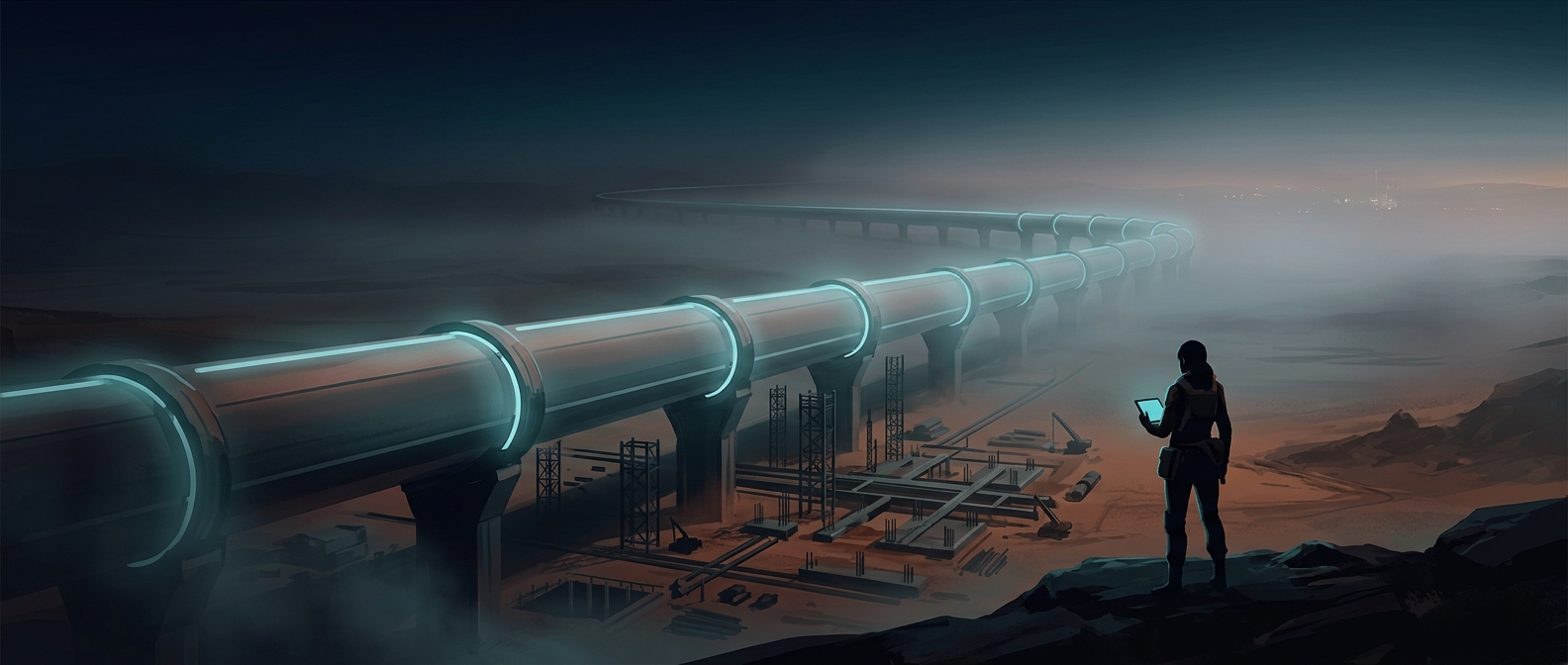
A low-pressure tube changes the engineering problem
A hyperloop is generally imagined as a passenger pod moving through a long tube where air pressure is reduced. With fewer air molecules in its path, the pod faces less aerodynamic drag—the resistance that rises sharply as vehicles move faster. Propulsion and guidance might use electric motors or magnetic systems, depending on the design; there is no single settled blueprint.
That promise is easiest to demonstrate over a short, controlled stretch. A small test track can show that a pod moves and that particular components work together. It does not establish that the same system can carry people reliably across a region, with stations, frequent service, and safe responses to failures.
The tube must work as a system
Keeping pressure low across a long route means controlling leaks and maintaining equipment along the tube. The structure also has to cope with temperature changes and movement in the ground without losing alignment or integrity. Those are not side issues: a defect in a sealed, high-speed corridor can affect the whole operating environment.
Passenger service adds another layer. Designers must account for braking, power loss, fire, medical emergencies, and how people could leave a pod or reach safety if it stopped between stations. A route also needs a practical way to admit and dispatch pods; tightly spaced vehicles in a confined tube leave less room to recover from delays than traffic on an open road.
A successful run is not a transit network
The gap between a test and a transport system is therefore not simply a matter of building a longer tube. It is the challenge of making propulsion, pressure control, structures, stations, and emergency procedures dependable together—and doing so at a scale where regular service is useful. Until those pieces operate as one passenger system, a fast test run demonstrates a component, not a new commute.