The Fairground Experiment That Put the Ground in Motion
Before moving walkways became familiar features of airports, they were presented as a way to solve a problem of distance: how to carry crowds across a large site without asking every visitor to walk the whole way. One early public demonstration appeared at the 1893 World’s Columbian Exposition in Chicago, a vast international fair that showcased industry and new inventions.
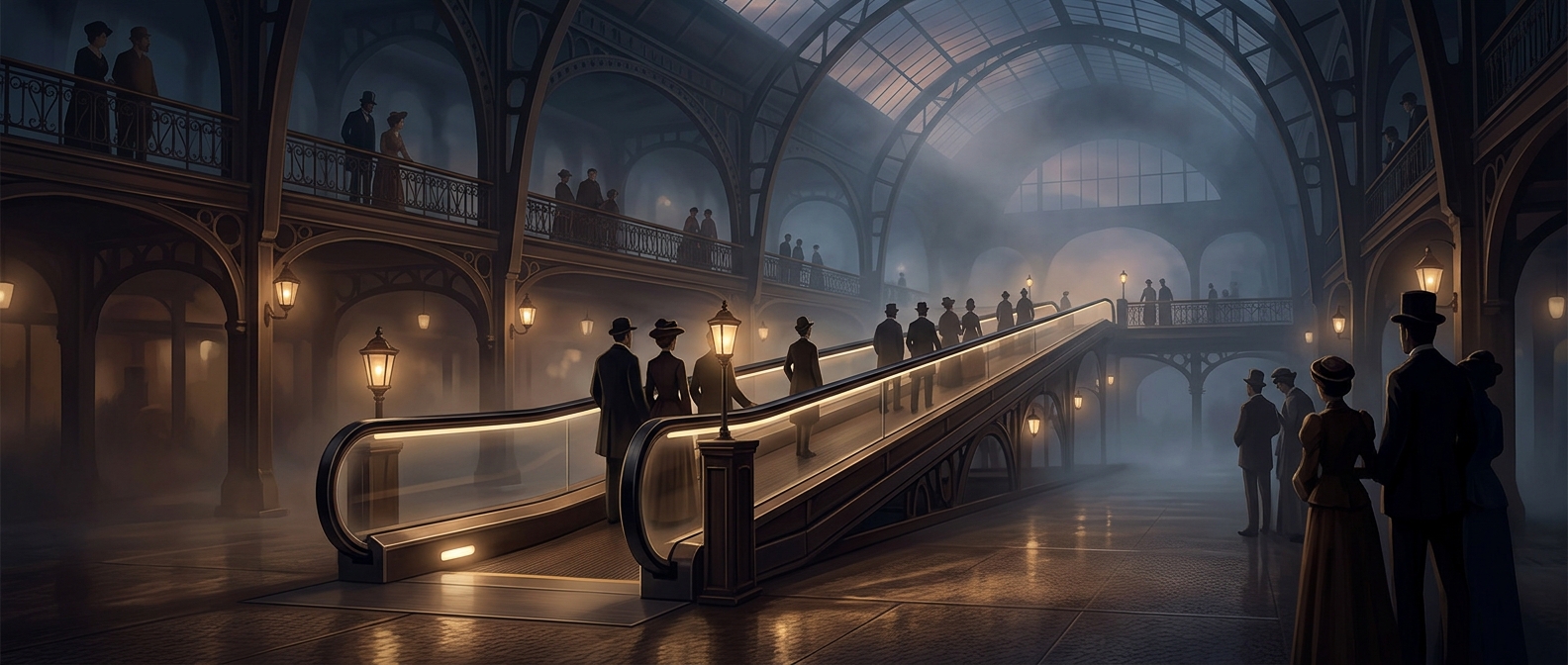
The idea was simple but striking. Instead of moving passengers in a vehicle with a driver, the walkway moved the surface beneath their feet. Visitors could step aboard and let the mechanism carry them along, turning a long connection between places into part of the spectacle.
Why an Exhibition Was the Right Place
An industrial exhibition offered more than a convenient crowd. It was a public test of whether unfamiliar machinery could work at scale and make sense to ordinary people. A moving walkway had to do both: keep operating as visitors arrived in waves, and make boarding and riding feel straightforward without specialized knowledge.
That practical challenge helps explain why the invention belonged at a fair as much as in a transport system. The exposition gathered people, buildings, and attractions over a large area; the walkway made the movement of those crowds visible as an engineering achievement in its own right.
The lasting idea was not that every street needed a moving floor. It was that short, heavily traveled connections could be mechanized without enclosing passengers in a train or elevator. Today’s airport walkways apply that same principle to long terminal corridors: the route remains open, but the ground does some of the work.