A game designed to fit in the gaps
A complex board game asks for more than players’ attention: it needs room to spread out, time to learn, and enough components to make and transport. At a convention, where people might have only a short break between longer games, those demands made a large new game a poor fit. The publisher’s request turned the problem around: instead of shrinking the board game, create something people could start quickly and carry easily.
Cards offered a practical answer. They are compact, familiar to handle, and simpler to package than a box full of board-game pieces. That made the fantasy game suitable for brief sessions—and gave it a form that could be produced and brought to conventions without the same manufacturing burden.
The cards made the game expandable
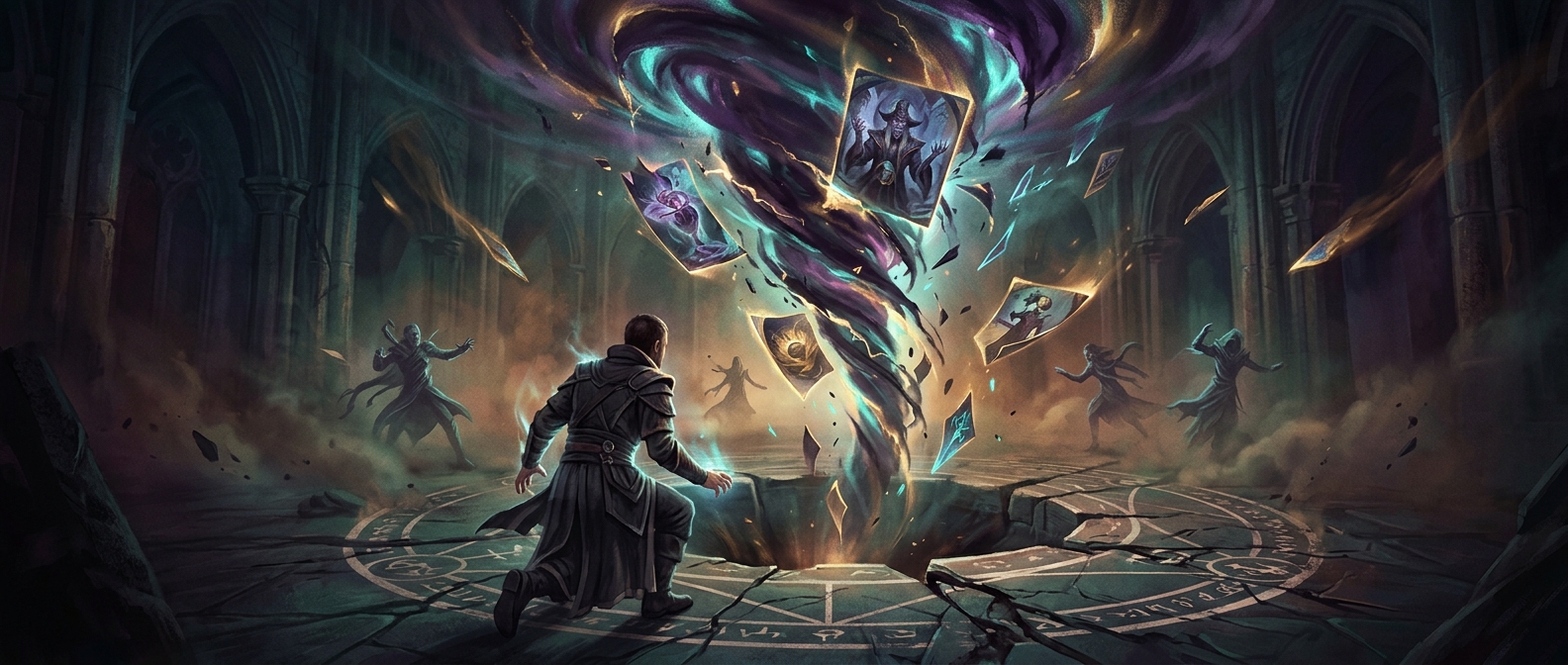
The design’s lasting advantage was not just its small package. Players could assemble their own decks from cards with different abilities, then bring those decks into play against one another. That gave each player room to shape a strategy while keeping the basic activity consistent: play cards, respond to an opponent, and try to win.
Because a deck could be changed, a new card could do more than add another object to a fixed game. It could alter the choices available, suggest a different strategy, or combine with cards a player already owned. The game could therefore grow through new releases without requiring a new board or a wholly separate rules system each time.
A small format with a long life
The convention brief solved an immediate practical problem, but it also pointed toward a different kind of game. Players could return to the same core rules with decks that differed from one another, and collecting cards became part of how they customized play. What began as a compact way to fill time between bigger games could keep offering new possibilities long after the convention ended.