How a Lunchbox Finds Its Way Across Mumbai
A dabbawala’s route is not one long trip from a home kitchen to an office desk. It is a chain of short trips, each handled by a worker who knows a particular part of the journey. A tiffin—a reusable, stacked metal lunch container—is collected from a household, grouped with other deliveries, carried to a sorting point, and passed onward toward the customer’s workplace. Later, the chain runs in reverse to return the empty container.
Labels Turn Handoffs Into Directions
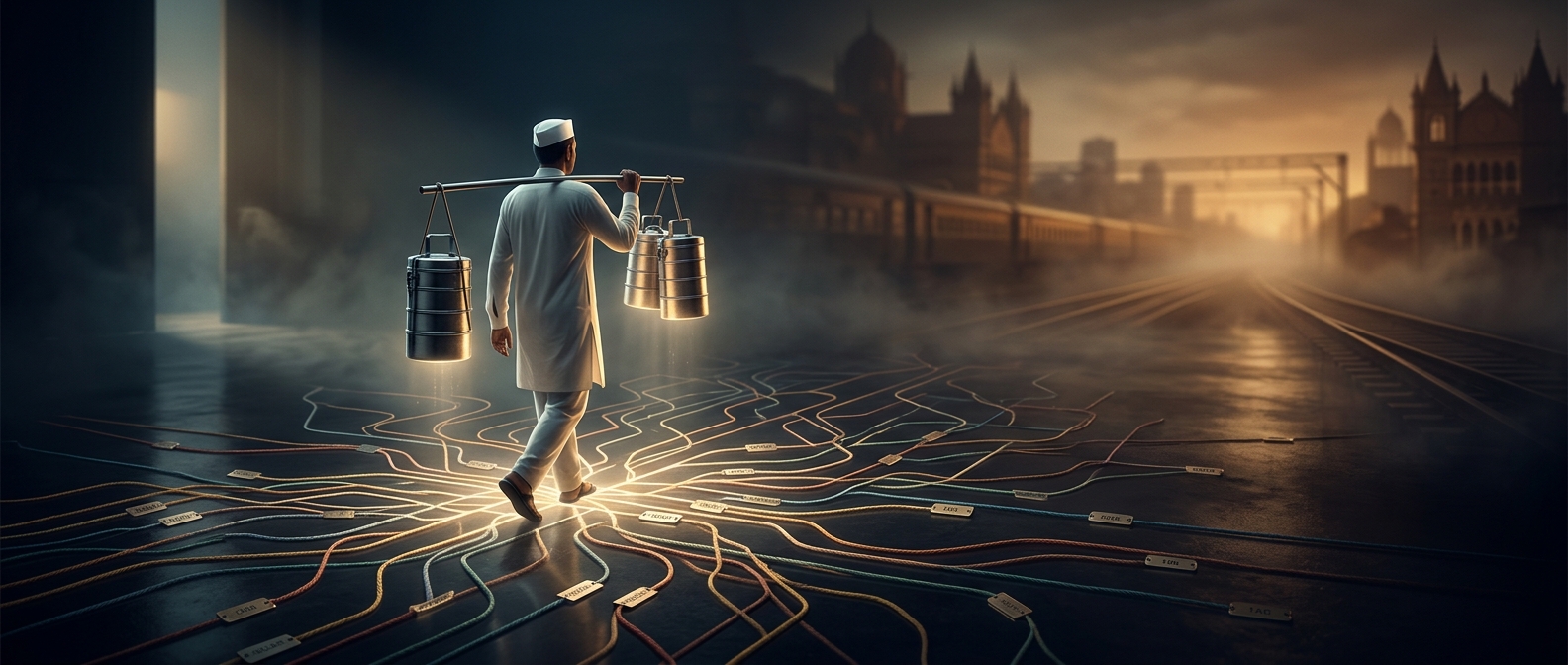
The markings on a tiffin act as a compact routing system. Their colors and symbols help workers recognize where the meal belongs and which route or handoff it needs next. At a busy transfer point, workers can sort containers into groups without reading a full address or consulting a screen. Each person needs to know the next step, not the entire journey.
That division of labor is the key: a worker can move a familiar group of lunches to a meeting point, where another worker takes over. Local trains carry many containers over longer distances, while people handle the collections, transfers, and final deliveries on either side of the ride. The system depends on connections arriving in the right order and workers recognizing the markings quickly.
A Network Built Around Repetition
Because the same routes and handoffs recur, workers can learn them through practice. The labels carry just enough information to keep containers moving through a human network, while routine supplies much of the coordination that software might otherwise provide. A lunch can therefore travel from a family’s kitchen to an office across a sprawling city through a sequence of ordinary, tightly timed exchanges—and still come back home as an empty tiffin.