How a Circle Became a Building
A circle looks simple on a drawing, but turning one into a high-rise is a structural puzzle. Most tall buildings rely on straight walls and rectangular frames: these give floors clear corners and provide familiar paths for carrying weight down to the ground. A circular outline removes those corners and curves the exterior, so the structure and the glass skin have to be designed to work together.
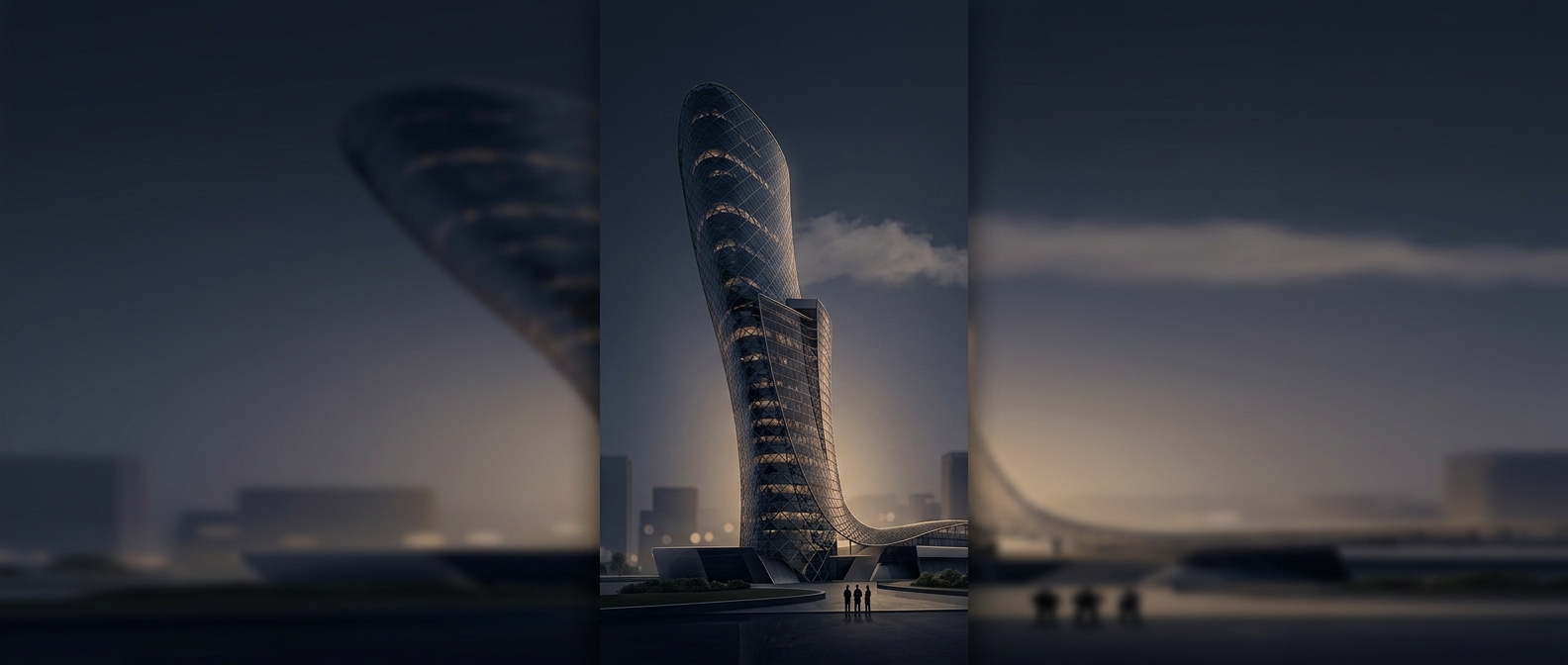
Aldar Headquarters solves that puzzle with a diagrid—a framework of intersecting diagonal members that forms a diamond pattern across the building’s exterior. The diagonals help carry the building’s loads, allowing the frame to follow the rounded shape rather than hide behind a conventional box. Glass fitted over that frame completes the smooth, coin-like profile.
A Landmark Made Legible from Afar
The design’s impact comes partly from its unusual silhouette. Viewed from the side, the curved glass surfaces meet in a narrow edge; viewed more frontally, the building reads as a large upright disc. That changing appearance makes the form easy to recognize across Abu Dhabi’s otherwise varied skyline.
Calling it a giant coin captures the impression, not the construction: the headquarters is a working office building, with floors and structure arranged inside a curved exterior. Its significance lies in making that practical interior fit a shape rarely used for a tall building. The result made the circular outline itself part of the city’s architecture, rather than merely a decoration applied to a conventional tower.