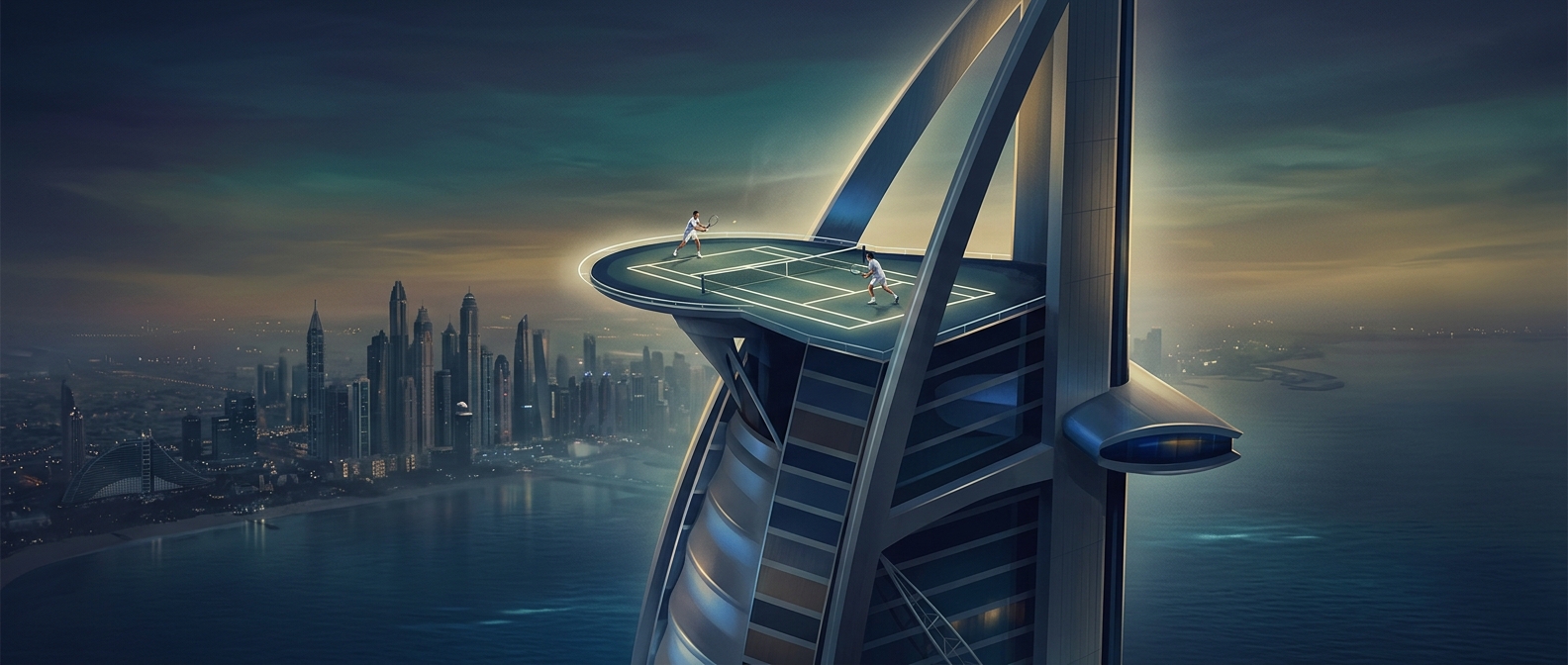
A landing pad with just enough room
The Burj Al Arab’s helipad was built for aircraft, not rallies. Its circular platform sits roughly 200 meters above the ground, and its usable space is only a little larger than a regulation tennis court. Because a court is a long rectangle, fitting one onto a circle leaves little margin at the corners—and even less room for players to chase a ball.
For the exhibition, organizers temporarily marked out a playing area on the pad. This was a one-off conversion, not a permanent court: the helipad still had to serve its aviation purpose afterward.
The height changed the game
A conventional tennis court has open space beyond its lines, so players can run after shots and balls can bounce out without immediately becoming a hazard. On the pad, the edges were close. There was no surrounding net to stop a stray ball, and a miss could send it off the platform. The players had to keep that unusual boundary in mind while moving and hitting.
Wind added another variable. High above the surrounding buildings, gusts can tug at a ball in flight, making a controlled shot less predictable. The challenge was not simply to play tennis at a dramatic height; it was to adapt a fast-moving sport to a compact, exposed surface.
A temporary spectacle
The 2005 exhibition featuring Andre Agassi and Roger Federer turned the hotel’s architectural feature into a stage. Its appeal came from the contrast: a familiar sport, usually played on a broad court, squeezed onto a platform intended for helicopters. Once the event ended, the pad could return to its ordinary job—an unusual court measured not only in lines, but in the few steps between a player and the edge.