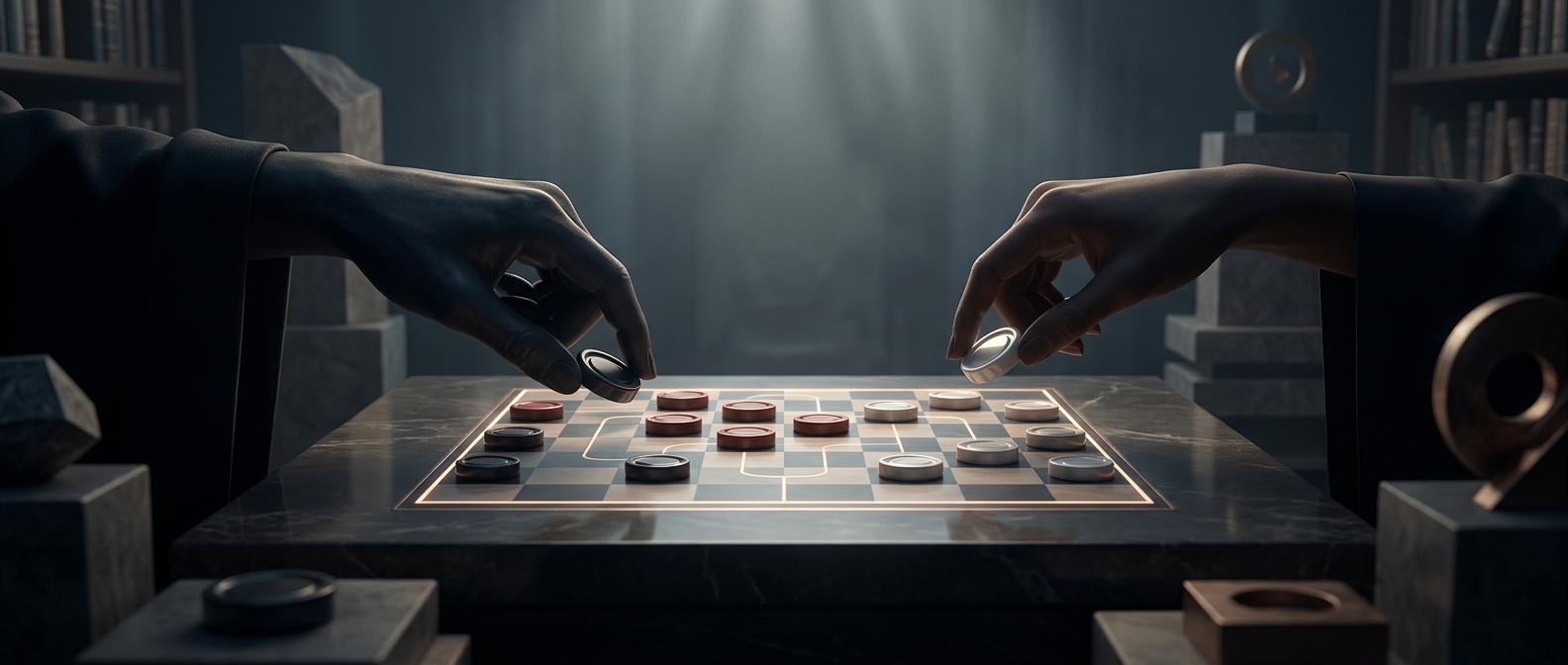
What “solved” means in checkers
In 2007, researchers established the result of standard checkers from its starting position: if both players choose moves that preserve the best possible outcome, neither can force a win. The game ends in a draw under perfect play.
That does not mean every checkers game is a draw, or that every position on the board is harmless. A player who makes a mistake can still lose. The result concerns the best strategy available to each side from the usual opening setup.
Searching a huge tree of possible games
The challenge was that even a simple-looking board can lead to an immense number of possible move sequences. Researchers used Chinook, a checkers-playing computer program, to analyze those possibilities. Search techniques let it focus on promising lines rather than examine every sequence blindly, while stored results for positions near the end of a game helped settle what would happen after many paths narrowed down.
The key was not to find one entertaining line that ended in a tie. It was to show that the player moving first had a way to avoid losing against any opponent strategy—and that the second player could also prevent a forced loss. Together, those guarantees establish a draw.
A draw is a strategic achievement
Checkers still rewards planning, because human players rarely calculate perfectly. But the proof changes what “winning” means at the highest level: against flawless opposition, the goal is not to force a victory but to avoid giving the other side one. The solved result applies to the standard starting position, while the many positions that arise during ordinary play can still be won or lost.