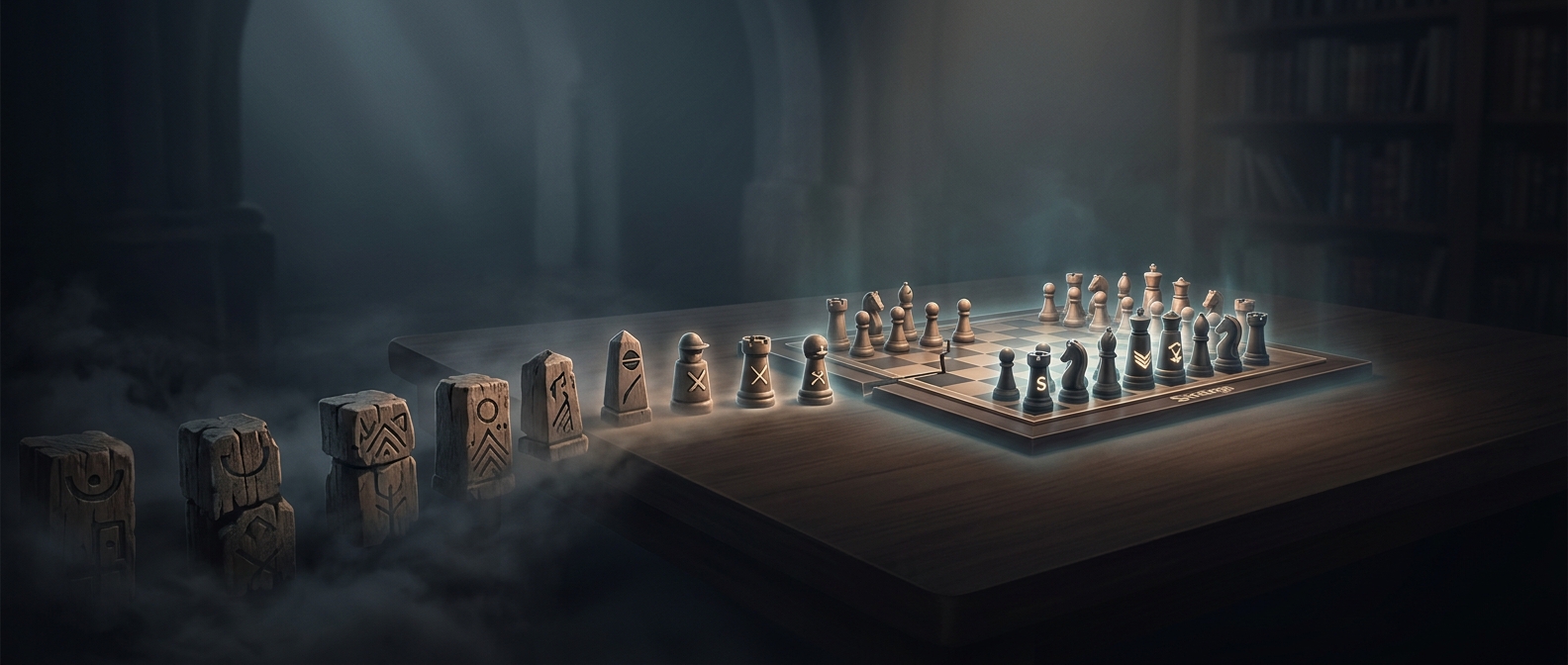
The French game behind Stratego’s hidden ranks
Stratego’s ancestor was L’Attaque, a French board game introduced in the early 20th century. Its central trick was to conceal each player’s pieces from the opponent. Players could see where an enemy unit stood, but not what it was—a distinction that turned every move into a judgment under uncertainty.
That hidden information changed the familiar military-board-game contest. Instead of simply comparing armies in the open, players had to probe, remember clues from earlier battles, and decide when to risk a stronger piece. A low-ranking unit could be useful not only for fighting but also for discovering what an opponent was hiding.
Why the bombs matter
Stratego made that uncertainty especially tangible with bombs: dangerous pieces that could not move, but could destroy most attackers. A specialized miner could remove them, so a player had to protect that scarce capability and infer where bombs might be placed. The hidden flag added a second problem: the goal was not to defeat every piece, but to find one particular target.
Those rules make deception structural, not just theatrical. A player can leave a weak-looking unit exposed to tempt an attack, or arrange defenses to make the flag seem to be somewhere else. The opponent must build a theory of the hidden army from limited evidence—and revise it whenever a clash reveals a rank.
The later game’s plastic pieces made the concealed identities easy to handle and keep secret, but the lasting design idea was older: a battlefield where what you cannot see shapes every decision. Each revealed piece narrows the mystery, while the bombs and flag ensure that even a small surviving unit can still change the outcome.