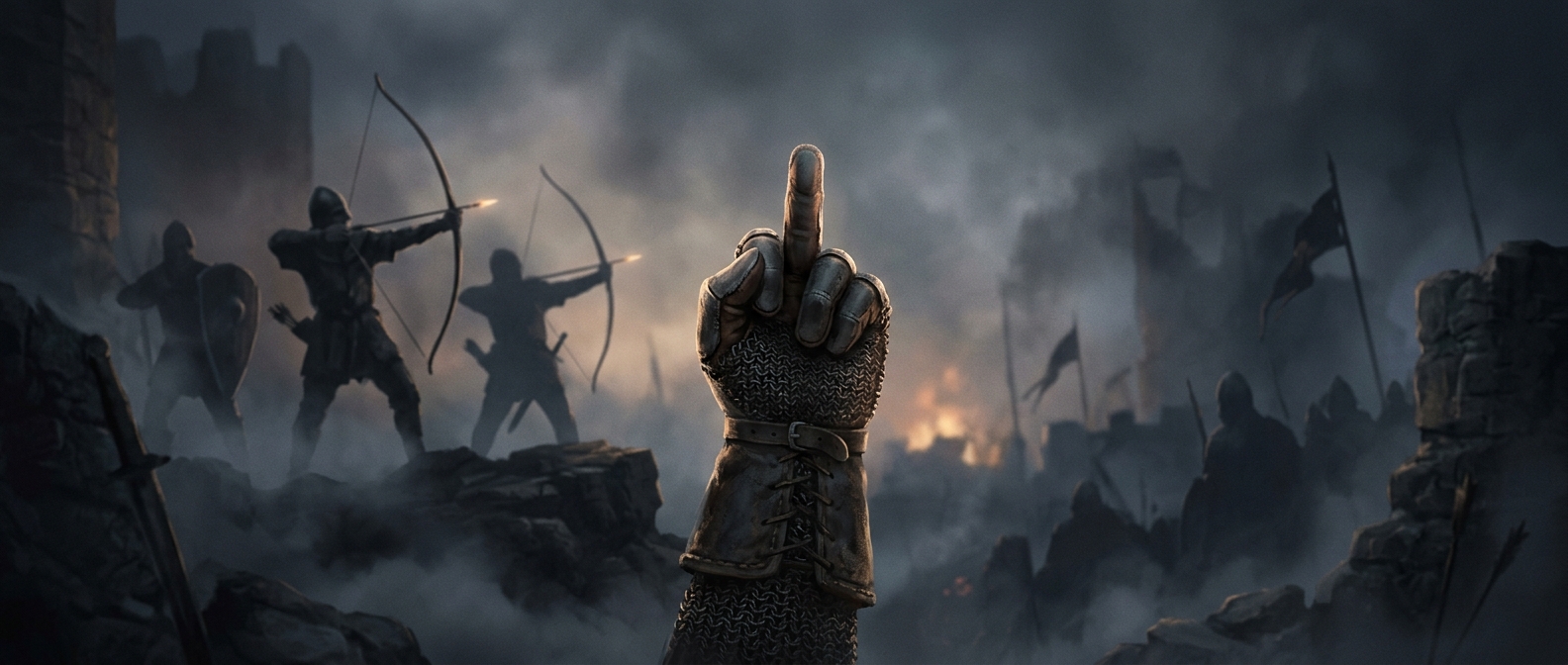
Why an archer’s middle finger mattered
A longbow is drawn by pulling its string back with the hand, and the middle finger takes part in that grip. Losing it could make the familiar three-finger draw difficult, though it would not necessarily make every form of archery impossible. That practical vulnerability gives the legend its force: the threatened injury targets the very skill that made an archer dangerous.
A defiant gesture—and an uncertain origin
In the story, French captors threaten to cut off English archers’ middle fingers; after victory, the archers display them to show they still have them. The gesture becomes a compact taunt: the weapon has not been taken from us, and neither have we been silenced.
But the tale is better treated as a legend than as a secure account of how the insult began. The obscene raised-middle-finger gesture was known in the ancient Mediterranean, long before the English longbowmen of later medieval warfare. That does not rule out archers using it in defiance, but it makes them unlikely to have invented it.
Why the story endured
The legend ties a familiar insult to a vivid, physical consequence. Instead of an arbitrary hand sign, the finger becomes proof of survival and a reminder of the enemy’s failed threat. Its lasting appeal lies in that neat reversal: the body part meant to be taken becomes the message of victory.