Why the Arch’s Last Piece Was So Difficult to Fit
The Gateway Arch was not assembled as a finished curve from the ground up. Crews built its two steel legs separately, working upward from opposite sides. Each leg grew into a long, increasingly slender cantilever—a structure supported at one end while the other projects outward. Until the legs met, there was no completed arch to brace them together.
That made the final connection a problem of geometry as well as fabrication. The top section had to meet both legs at once, matching their position and angle closely enough for the steel joints to connect. A small mismatch at the crown could mean that the carefully assembled parts would not line up.
How Builders Kept the Two Sides on Course
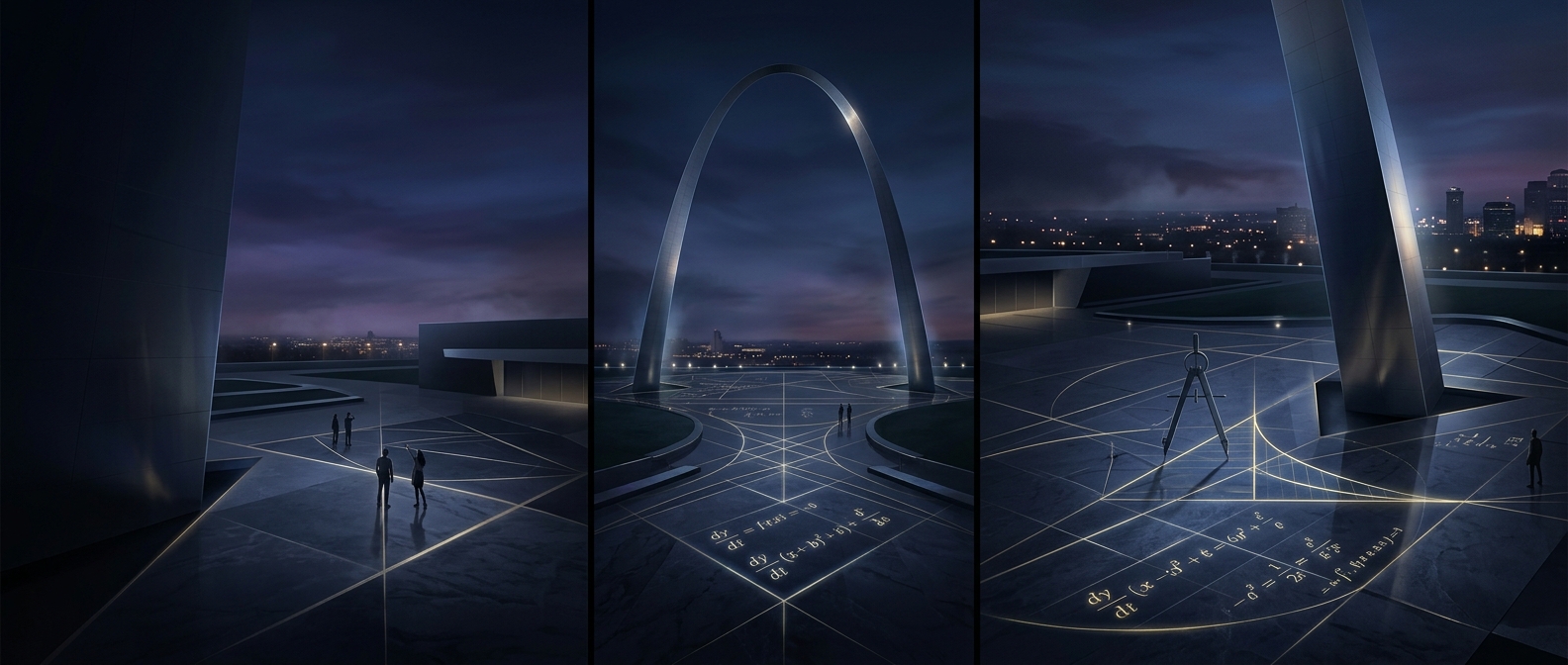
The arch’s curve follows a weighted catenary: the shape a hanging chain takes when held at both ends, turned upside down. Engineers used that mathematical curve to define the structure, while survey measurements helped crews track whether each rising leg stayed on its intended path.
The legs were assembled from steel sections, so accuracy depended on a chain of precise fits, not just on getting the final piece right. As construction advanced, workers had to keep checking the growing structure’s position. Near the top, hydraulic jacks could make small adjustments to bring the legs into alignment for the closing section.
A Landmark Made by a Meeting Point
The challenge was that steel and large structures can shift slightly with temperature and load. The opening at the crown was therefore not simply a fixed gap waiting to be filled; its size and alignment depended on the legs’ actual positions as construction proceeded. The final connection turned two separate, carefully controlled builds into one continuous arch.
That hidden construction story gives the Gateway Arch its distinctive engineering drama: its monumental curve depended on a meeting point precise enough to join two independently rising legs into a single structure.