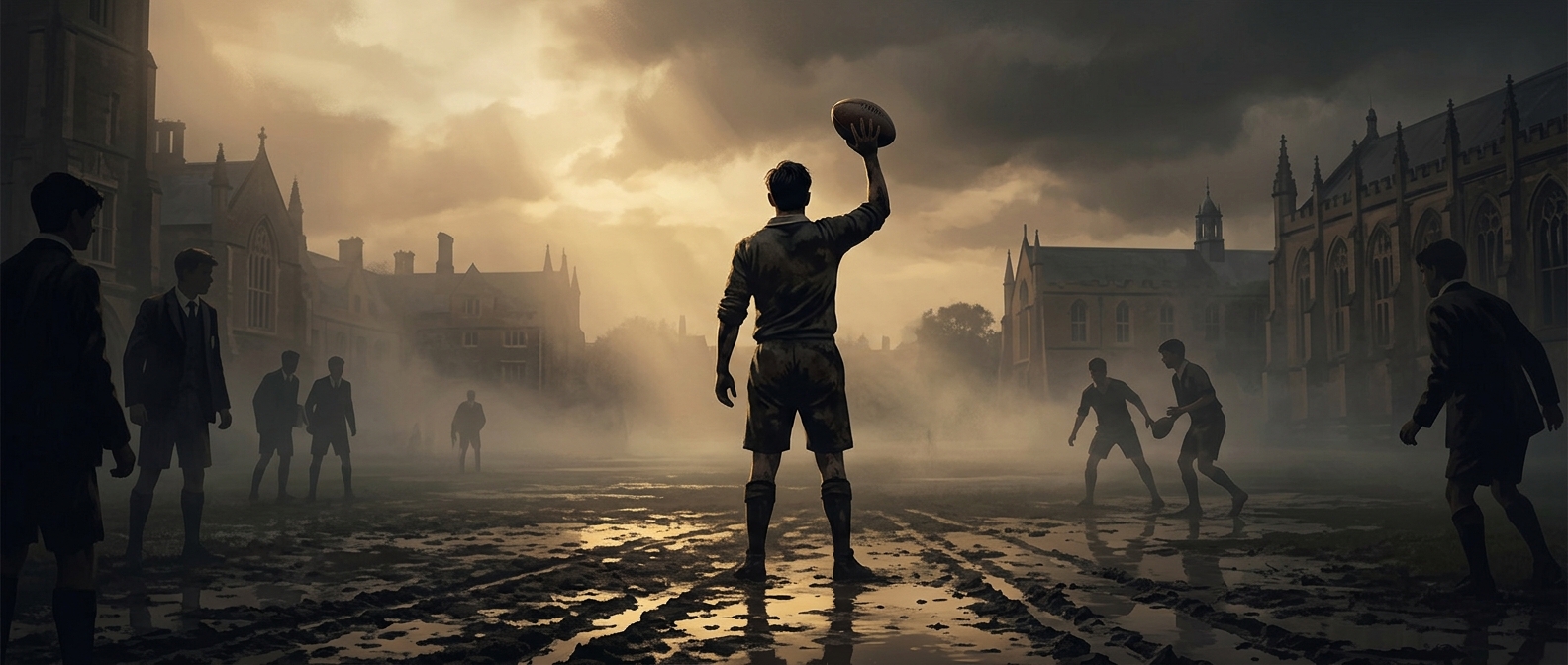
A run that became rugby’s origin story
The Webb Ellis tale gives rugby a memorable starting point: one student breaks from kicking and carries the ball instead. But the familiar version is a legend, not a verified account. It took shape long after the event it describes, and it cannot establish that one person invented the sport.
Its staying power comes from how neatly it captures a real difference between kinds of football. In association football, players generally advance the ball by kicking it; rugby makes carrying the ball forward a central part of play. The story turns that contrast into a single, dramatic decision.
From school play to shared rules
The legend also points toward how the sport developed. In the nineteenth century, schools played their own versions of football, with local rules about handling, running, and contact. A game in which players could carry the ball needed ways to contest possession and restart play when a runner was stopped. Rugby’s characteristic collisions and set pieces grew within that kind of rule-bound contest—not from one impulsive run alone.
Once players from different schools wanted to compete, they needed agreed rules. That process made a local style of football into a recognizable sport, while other versions developed along different paths. Rugby’s name preserved its association with Rugby School; Webb Ellis gave that association a vivid human face. The legend is worth repeating not as proof of a lone inventor, but as a snapshot of the choice that separates rugby’s style of play: when you have the ball, you can run with it.