The light comes from a disk, not the black hole
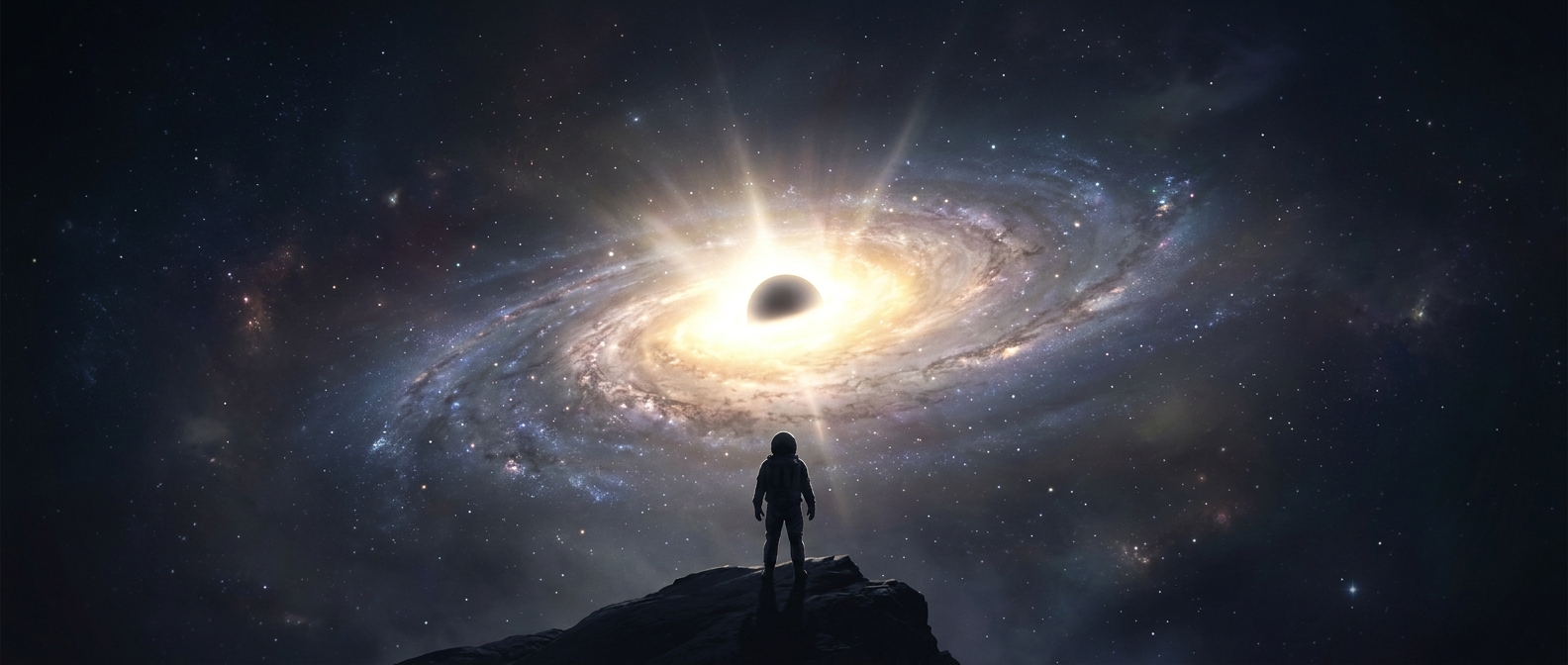
A quasar is the brilliant central region of a galaxy where a supermassive black hole is pulling in matter. The black hole itself gives off no light that can escape. The spectacle comes from gas gathering around it in a flattened, rapidly rotating structure called an accretion disk.
As gas spirals inward, neighboring layers move at different speeds. Their interactions—through friction and turbulent collisions—convert some of the gas’s motion into heat. The inner disk can become so hot that it radiates intensely across many wavelengths, including visible light and X-rays.
Why the center can overpower the galaxy
The gas releases energy as it falls deeper into the black hole’s gravitational field. A small amount of matter can therefore produce a huge output of radiation, especially when it is being fed inward quickly. In a quasar, the disk’s concentrated glow can exceed the combined visible light of the galaxy’s stars.
That contrast is striking because a galaxy’s stars spread their light across an enormous area, while the quasar’s energy comes from a compact region near its center. From far away, the bright core can wash out the surrounding galaxy, making the source look almost star-like even though it is powered by a much larger system.
A bright signal from a dark engine
The quasar’s brightness reveals what is happening to matter before it crosses the black hole’s boundary. Once gas passes that point, its light cannot get back out; before then, the infalling material can radiate fiercely. The darkness of the black hole and the brilliance of the quasar are two parts of the same process: matter loses energy on its way in, and that energy escapes as light.