A screw turns a twist into a pull
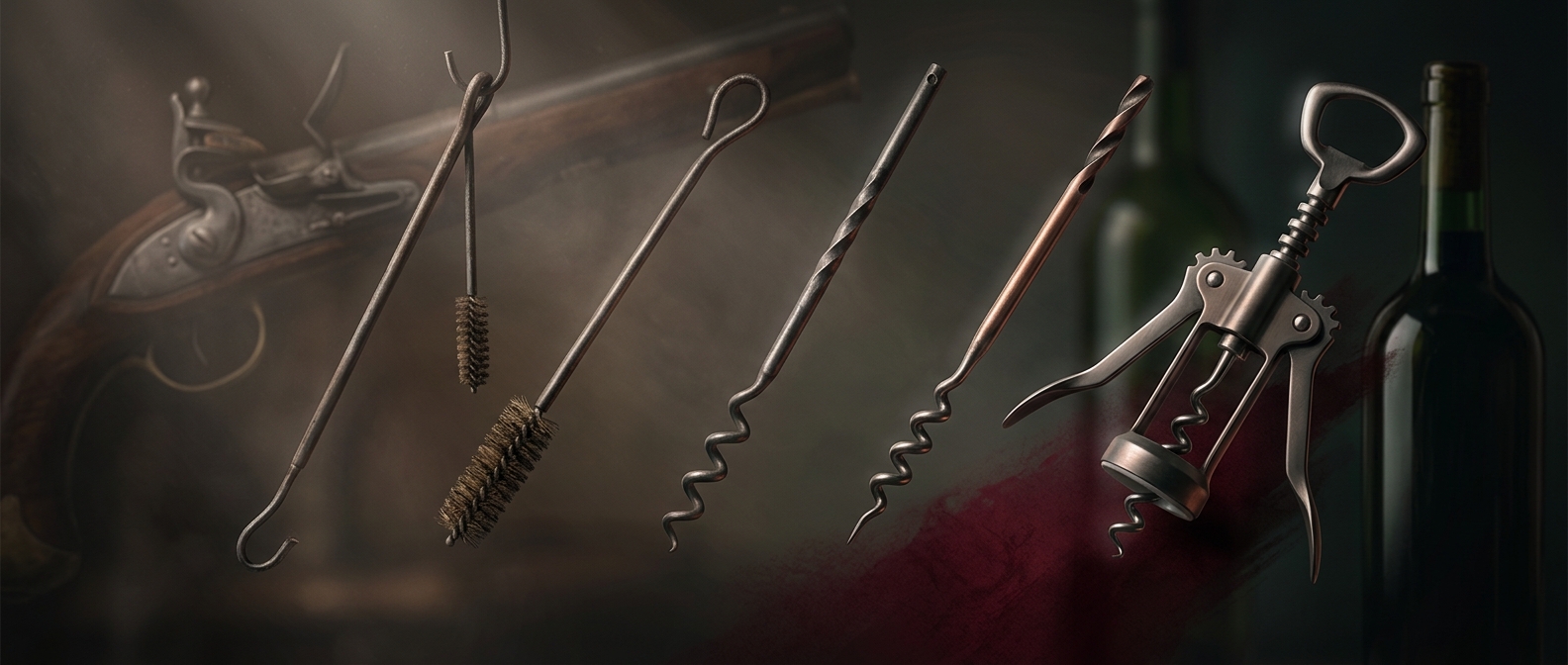
A gun worm and a corkscrew solve the same mechanical problem: how to get hold of something lodged inside a narrow tube. Their helical shape—a ridge winding around a central shaft—lets the tool bite into soft material as it turns. Once embedded, the shaft provides a handle for pulling the material back out.
A cork is especially suited to this approach. Pressed into a bottle neck, it seals by fitting tightly against the glass. A straight hook would have little to catch on, but a pointed spiral can work into the cork and hold it from within. The bottle neck then guides the cork upward as the user pulls, while the cork’s slight compression helps it slide through the opening.
From clearing barrels to opening bottles
The shift was less a change in engineering than a change in what the tool needed to retrieve. A musket’s narrow barrel could retain a ball or wadding—a wad used to keep the charge in place—and the gun worm was made to reach and grip material inside it. Bottle stoppers created a similar access problem, but on a smaller scale and with a different kind of material.
That shared action explains why the old tool is described as a corkscrew’s ancestor: the essential idea survived even as the task changed. The next time a cork rises with each turn, the movement is doing more than drilling into it—the spiral is converting rotation into a firm grip that makes extraction possible.