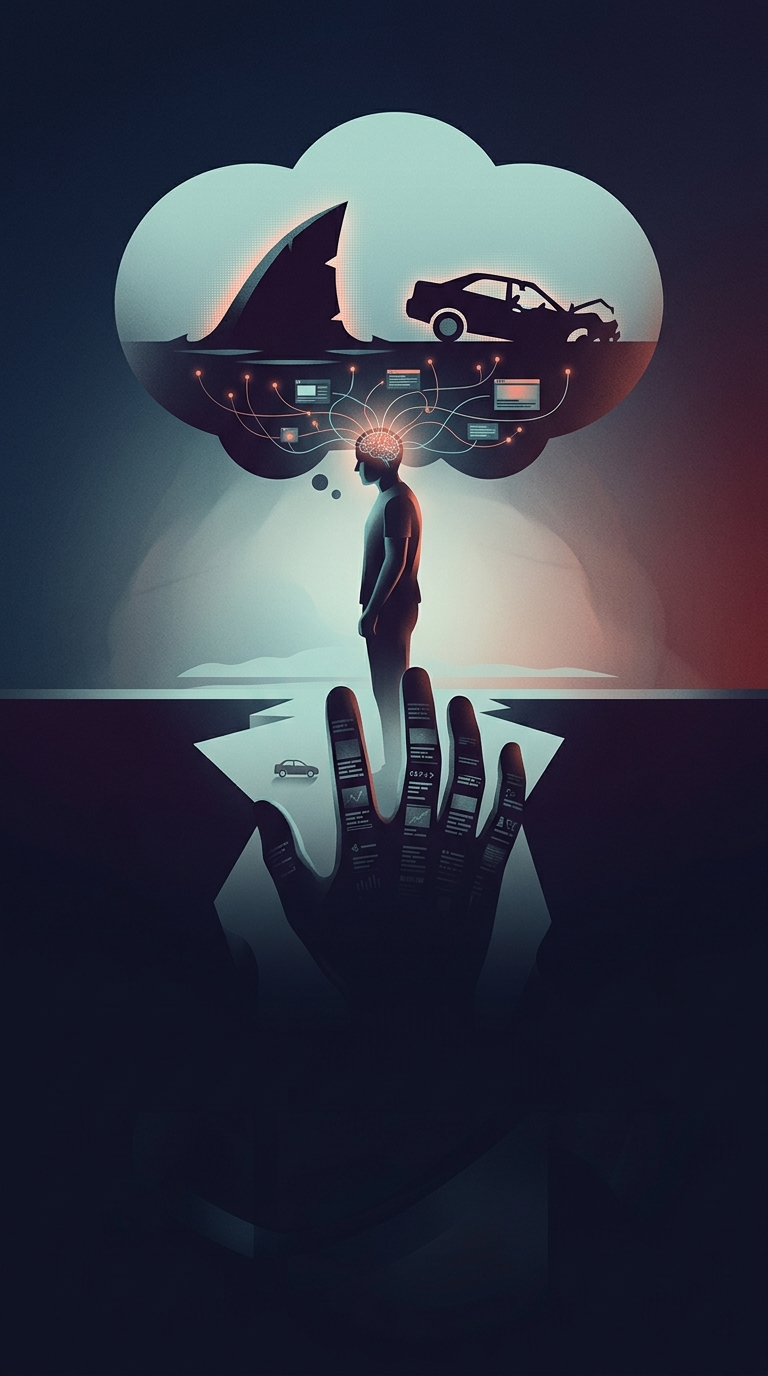
Why a shark feels more frightening than a car
A shark attack is a vivid, easy-to-picture threat: a person enters the water, an animal appears, and danger seems to arrive without warning. A fatal car crash is also sudden and frightening, but it happens within a routine many people perform every day. Familiarity can make a danger feel ordinary even when its consequences are severe.
Psychologists often describe one part of this gap as the availability heuristic: people tend to judge how likely something is by how readily examples come to mind. A dramatic attack, especially one repeated in news coverage or popular culture, is easier to recall than the many uneventful drives that make up everyday life. Ease of recall can feel like evidence of likelihood, even though it is not a reliable measure of risk.
Fear is shaped by control and dread
People also tend to feel more alarmed by threats they see as unpredictable, uncontrollable, and potentially catastrophic. In the water, a swimmer may feel exposed and unable to influence what an animal does. In a car, drivers may believe that attention, skill, or safety features give them some control. That sense of agency can soften fear, though it does not make a crash harmless or guarantee safety.
The result is a mismatch between emotional intensity and statistical danger. Risk depends on the chance of an event and the circumstances in which people encounter it; fear depends partly on how imaginable and controllable the event feels. The shark looms in the mind because it is exceptional and memorable; the car can fade into the background because it is familiar.