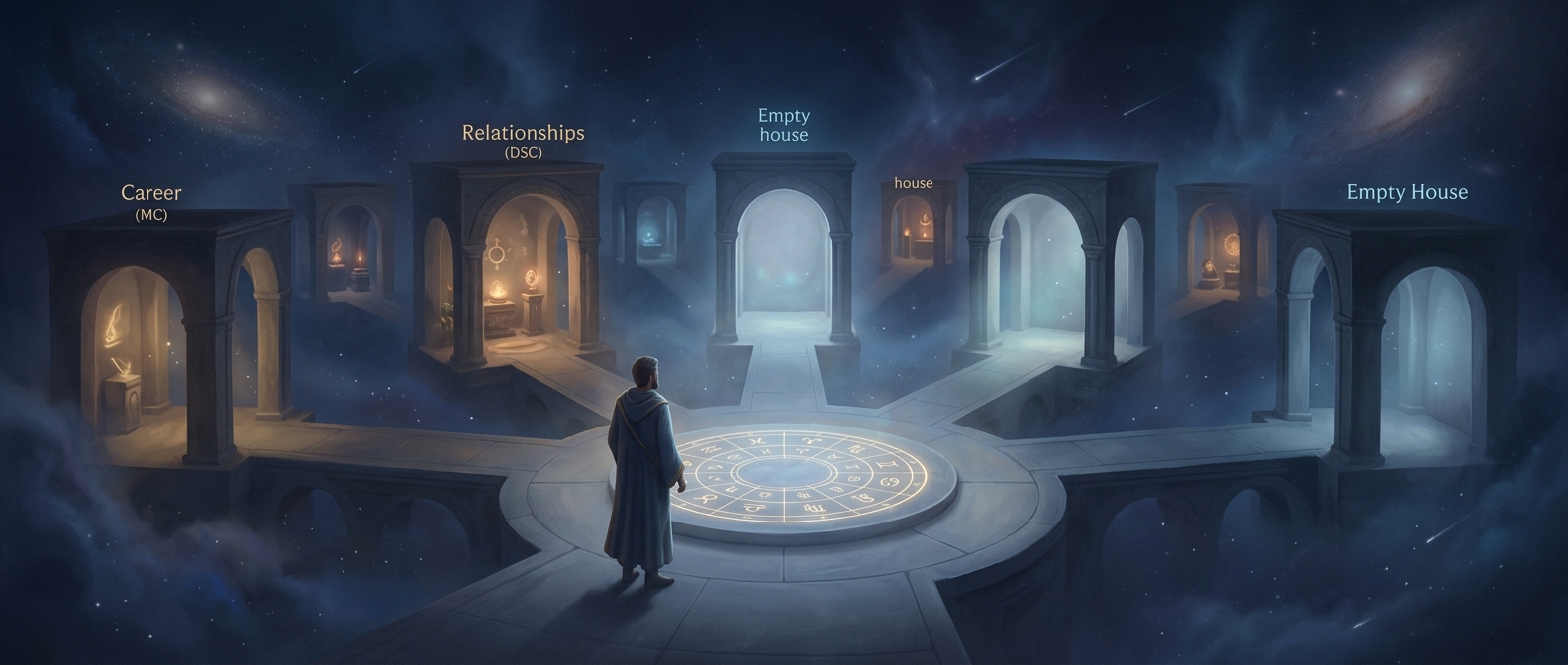
What an Empty House Means in Astrology
An astrological house represents an area of life—such as relationships, work, home, or shared resources. A house is called “empty” when no planet appears within it in a birth chart. That describes the chart’s layout, not an absence of that life experience or an inability to handle it.
Astrologers often treat planets as the chart’s active symbols: their placements are thought to bring particular themes into sharper focus. A house without a planet has no natal planet there to interpret, but astrologers do not generally treat it as erased or sealed off.
The House Still Has a Sign and a Ruler
To read an empty house, an astrologer may look at the zodiac sign on its cusp—the boundary where the house begins—and identify that sign’s ruling planet. They then consider where that planet sits in the chart and what aspects, or angular relationships, it makes with other planets. In this approach, the house’s story is traced through its ruler rather than through a planet placed inside the house.
For example, an empty partnership house is not automatically read as a lack of relationships. The sign on its cusp and the placement of its ruler may offer the astrologer a way to discuss how partnership themes connect with other parts of the chart.
Why an Empty House Can Become Noticeable
A birth chart is a snapshot, while astrologers also interpret later planetary movements, called transits. When a moving planet passes through an empty house, the astrologer may read that period as bringing the house’s topics into temporary focus. The house can therefore matter in a reading even if it contains no planet at birth.
The practical distinction is between a chart area with fewer natal planetary placements and a life area that is supposedly missing. Within astrology’s symbolic framework, an empty house is a quieter starting point—not a verdict about what a person can experience.