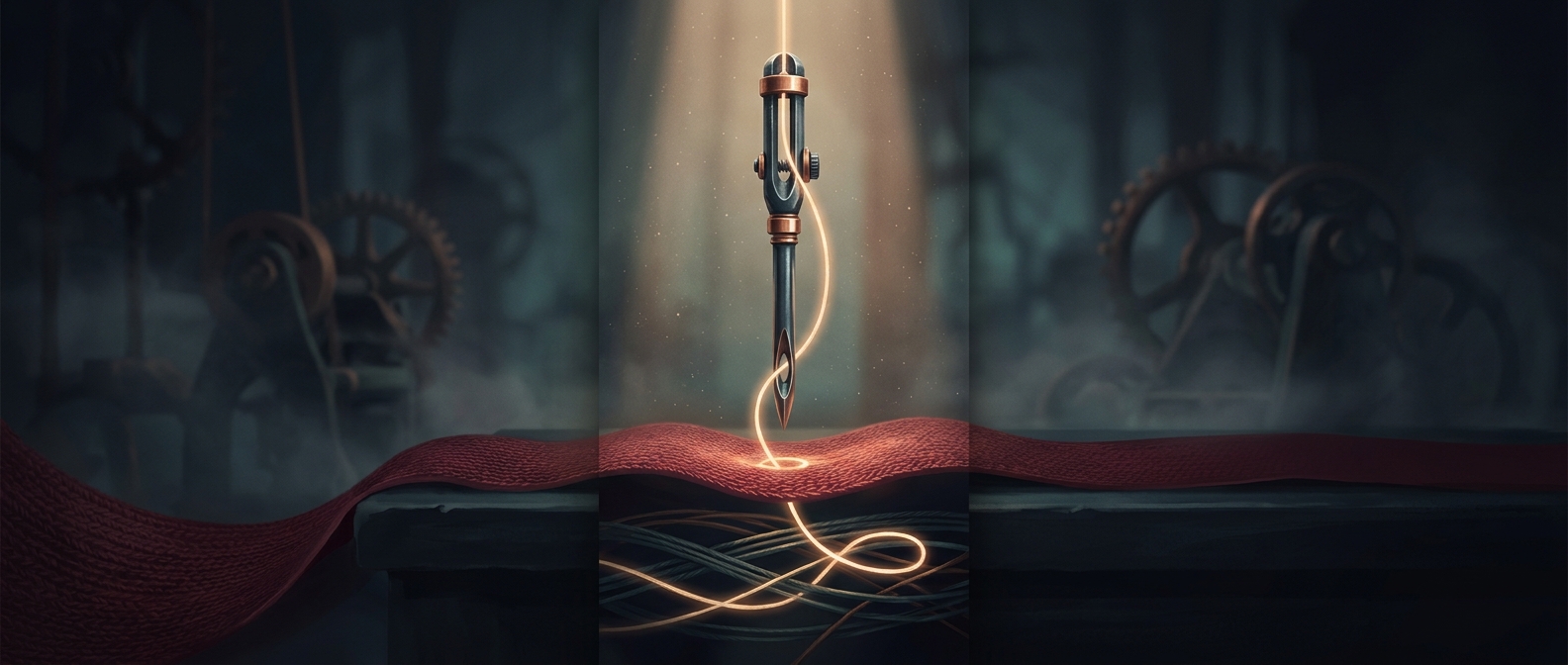
How a sewing machine makes a stitch
A sewing machine does not simply push thread through fabric and pull it back out. It uses two threads, one from the needle and one from a bobbin beneath the fabric, and links them together to make each stitch.
As the needle descends, its point carries the upper thread through the cloth. When the needle starts to rise, friction holds the thread briefly against the fabric, allowing a small loop to form on the needle’s lower side. A rotating hook catches that loop and guides it around the bobbin thread. The two threads then tighten together inside the fabric.
Why the eye sits so close to the point
The eye—the opening that holds the thread—needs to pass below the fabric surface so the thread can form a loop where the hook can reach it. If the eye were near the needle’s top, the needle could pierce the cloth while the thread stayed above it. The machine would have no accessible loop beneath the fabric to catch, and the stitch would not form in the usual way.
The needle’s shape also helps control the thread. Just above the point, a shallow groove shelters it as the needle passes through the cloth, while a small indentation on the opposite side gives the hook room to catch the loop. These details coordinate the needle’s movement with the hook’s timing.
That is why a sewing-machine needle is unlike a hand-sewing needle: its eye is placed near the point not for convenience, but to bring the thread through the fabric at precisely the spot where the machine can turn it into a stitch.