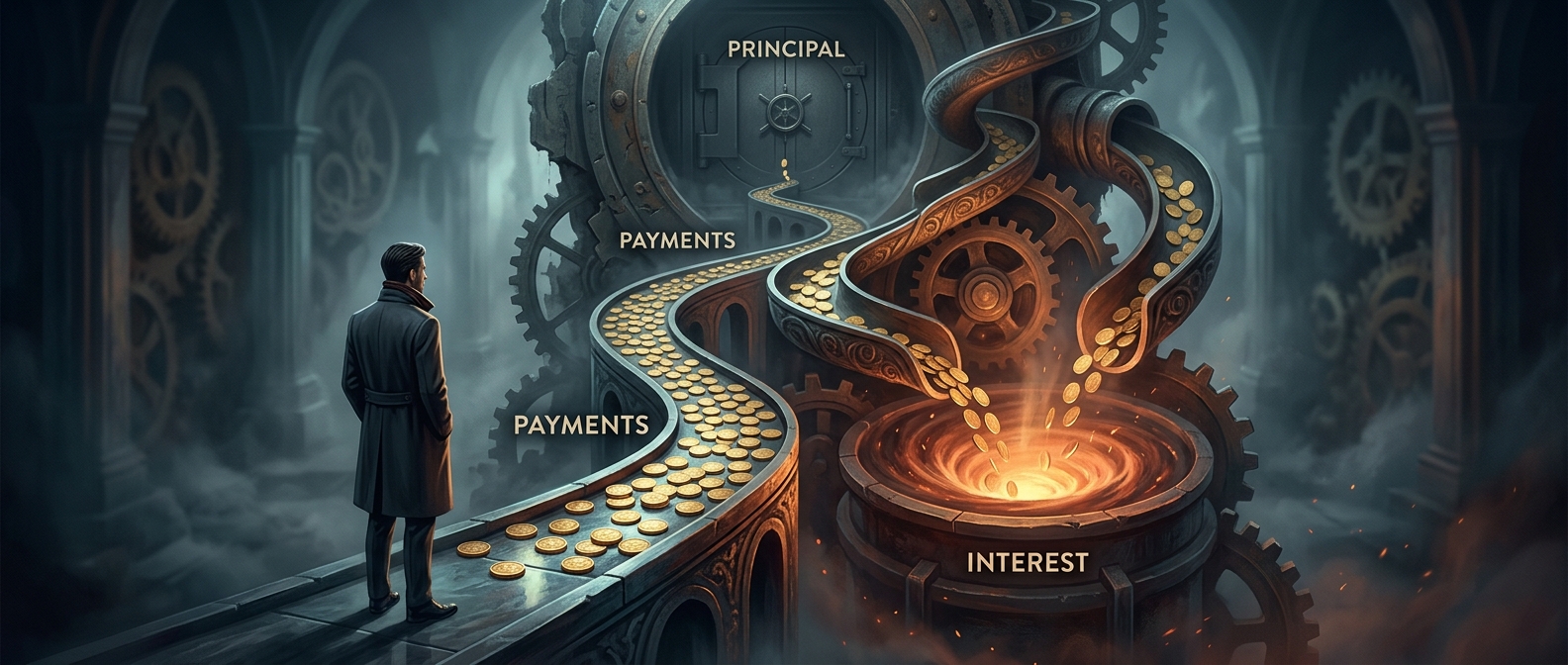
Why a fixed loan payment changes its job over time
A lender calculates interest on the amount you still owe, called the principal. With a typical fixed-rate, fully amortizing loan, each payment covers the interest that has accumulated since the last payment; whatever remains goes toward principal. Amortization is the process of spreading repayment of that principal across the loan term.
At the beginning, the balance is large, so the interest charge takes up a bigger share of the payment. As principal is paid down, the next period’s interest is calculated on a smaller amount. If the payment stays the same, the portion left to reduce principal grows. The payment has not changed, but its two jobs have gradually traded places.
Why the shift can feel slow
Each early payment does reduce the balance, but only a little. That small reduction also means the next interest charge is only slightly lower, so the principal portion may grow slowly at first. Later, after more principal has been cleared, the interest share falls more noticeably and the balance can begin shrinking faster.
For example, on a hypothetical loan charging 1% interest per month, a $1,000 balance accrues $10 in interest over a month. A $100 payment would leave $90 to reduce principal. After the balance falls, the same rate produces a smaller interest charge, leaving more of that $100 for principal.
This is why looking only at the payment amount can be misleading: two payments of the same size may have very different effects on the debt. The payment schedule is built so the loan reaches zero by the agreed end date, assuming payments are made as scheduled and the rate and terms do not change. Extra principal payments, when permitted and applied to the balance, can reduce the amount on which future interest is charged.