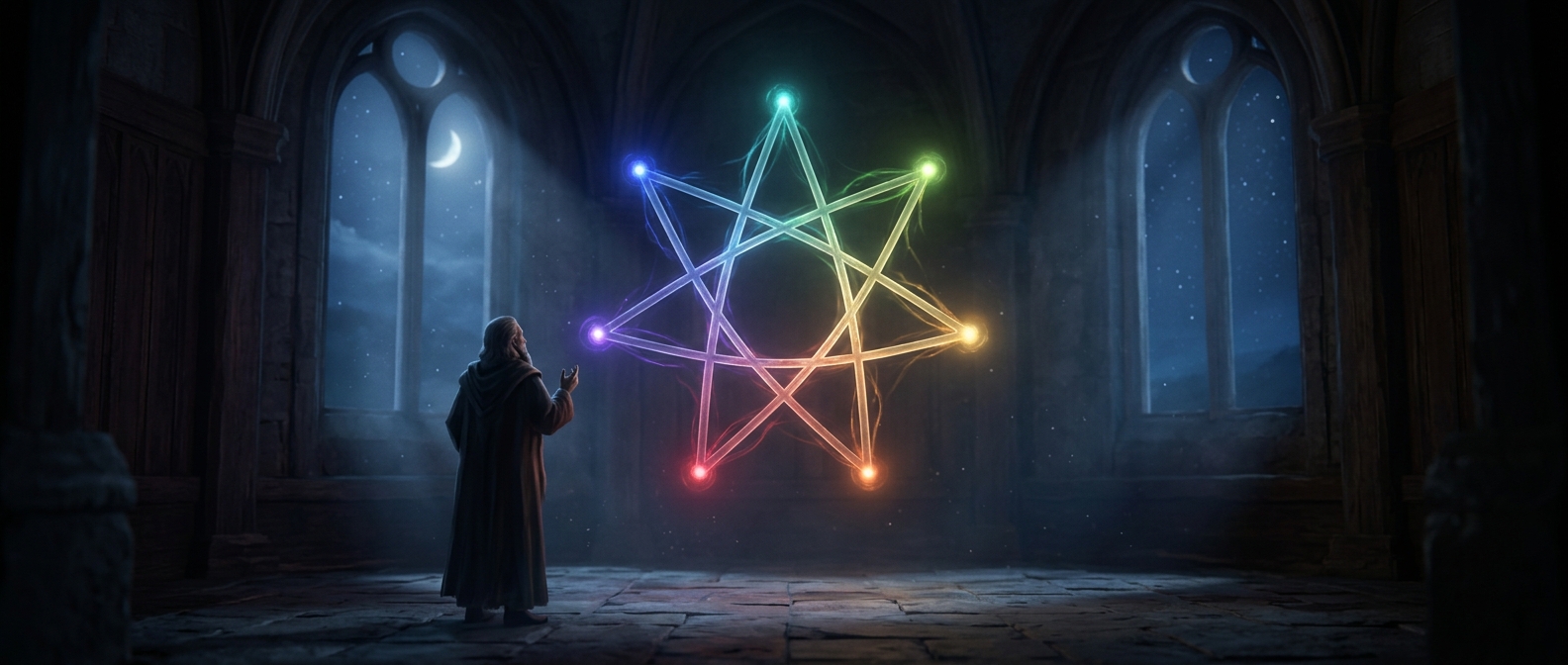
A Seven-Pointed Star as a Symbolic Map
In some esoteric systems, a heptagram—a star with seven points—serves as a diagram for seven distinct energetic states. “Energy” here belongs to the system’s symbolic or spiritual vocabulary; it does not necessarily mean a measurable physical force. The points give otherwise abstract categories a visible arrangement, making them easier to contemplate as parts of a whole.
The meaning is not universal. Different systems can assign different qualities or stages to a seven-part scheme, so the star’s significance depends on the tradition using it rather than on a single fixed interpretation.
Why Drawing It Demands Attention
A heptagram can be made by marking seven positions around a circle and connecting them in a chosen repeating pattern. Because seven does not divide evenly into the familiar four- or eight-part layouts, keeping the points evenly spaced takes care. A small error can make the star look lopsided or cause the connecting lines to miss their intended points.
That precision can also shape the practice. Tracing the route requires sustained attention: the hand follows a sequence while the mind holds the diagram’s seven-part structure in view. For someone using the star as a contemplative map, the act of drawing can become part of engaging with the states it represents—not merely a way to produce the symbol.
The result is a compact diagram that asks the practitioner to attend to both its parts and their relationships: seven distinct points, held together within one form.