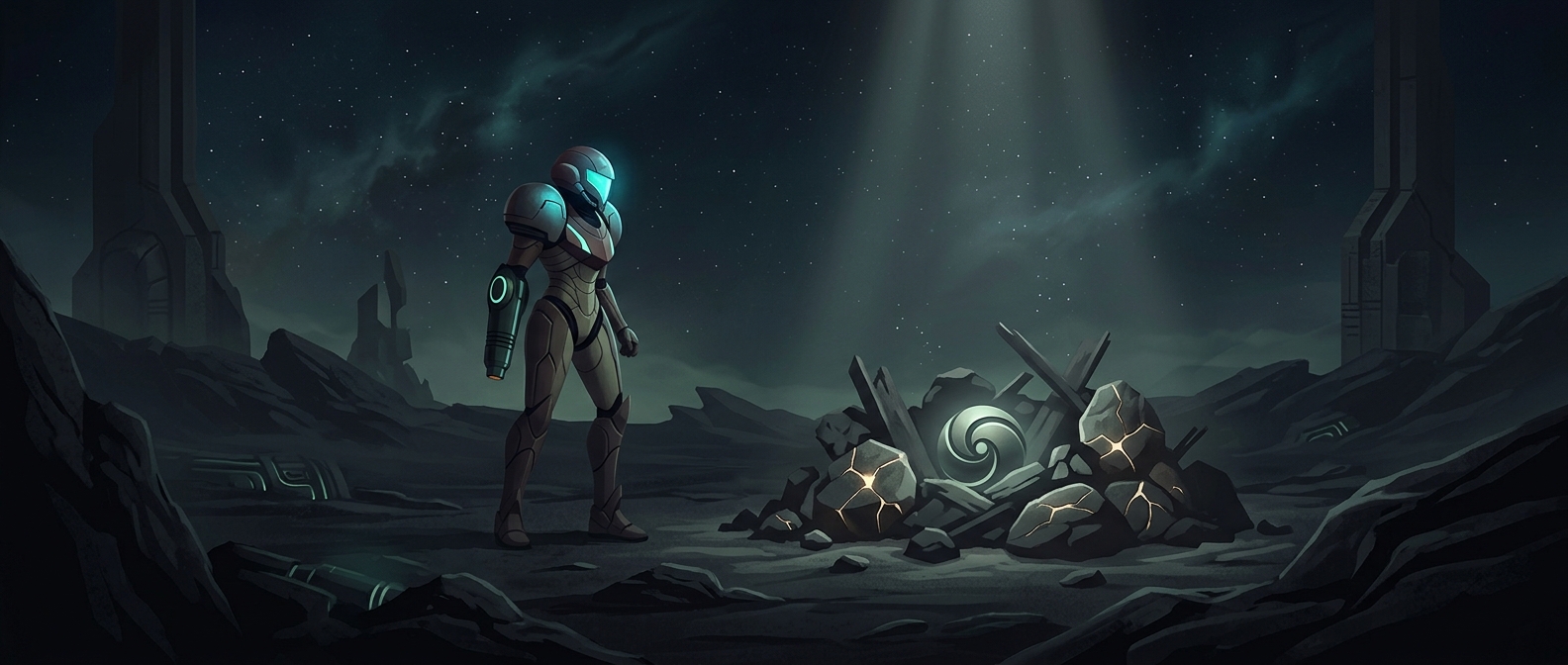
A Wall Can Be a Clue, Not a Barrier
In Metroid, a blocked passage does not always mean Samus needs to find a key or reach a distant switch. Sometimes the answer is concealed nearby: a section of wall that looks ordinary but can be destroyed with a bomb. Behind it may be an upgrade—such as a new ability—that lets Samus overcome the obstacle she just encountered.
That arrangement turns exploration into a small reasoning loop. The player meets a barrier, searches the surrounding rooms for something suspicious, and returns with a new tool. The level is not simply a sequence of locked doors; its rooms contain clues about how to move forward.
How the Hidden Wall Teaches the Player
Early encounters establish that the environment itself may be breakable. Once players learn to test walls with bombs, they carry that lesson into later rooms. A hidden upgrade can then reward curiosity without requiring the game to announce exactly where to look.
The placement matters: a useful item tucked near an obstacle can connect the discovery to its purpose. The player finds a new capability, then recognizes that it may solve the problem close by. Progress feels earned through observation and experimentation, not just through following an explicit marker.
Exploration Has a Cost
The same design can also make players methodically bomb walls, since a convincing fake wall may be difficult to distinguish from a solid one. That uncertainty is part of the tradeoff: concealment makes discoveries satisfying, but too many indistinguishable secrets can turn exploration into trial and error.
At its best, the hidden wall changes how a player reads the planet. A surface that seemed like scenery becomes a question: what if the route forward is already here, just out of sight?