Why the Moon Raises Seas but Not Body Fluids
The Moon’s gravity does pull on every part of Earth, including people. The key is not whether gravity acts on us, but whether it differs noticeably from one side of an object to the other. That difference is called a tidal force: it stretches an object slightly because the nearer side feels a little more gravitational pull than the farther side.
Why the Ocean Responds
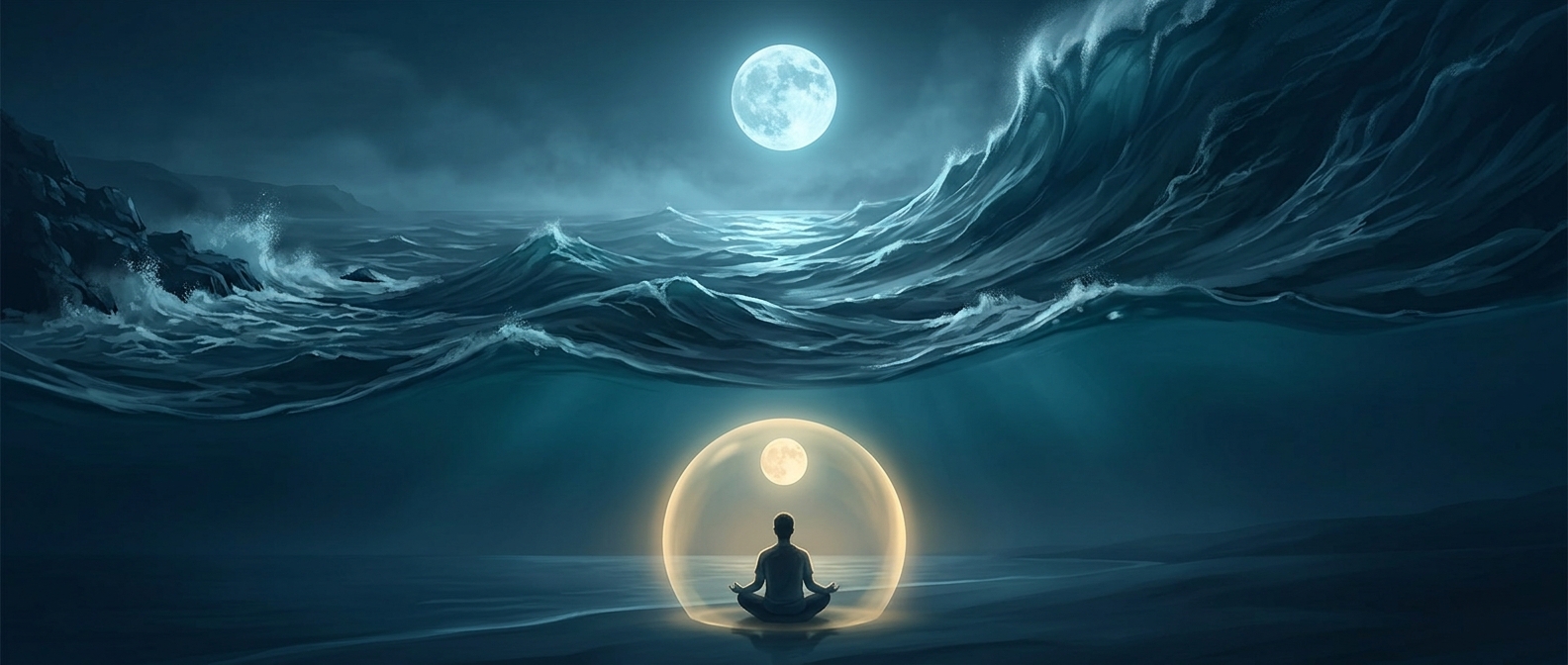
Across an ocean, the Moon’s pull varies from one place to another over distances of thousands of miles. That small difference can redistribute enormous masses of water, producing the familiar rise and fall of tides. Coastlines and seabed shapes then funnel or spread that movement, which is why local tides can differ considerably.
Inside a person, the relevant distances are only inches or feet. Across that short span, the Moon’s gravitational pull changes so little that its tidal effect is overwhelmed by ordinary forces: gravity from Earth, pressure from surrounding tissue, and the motion of the body. Water in blood or cells is also held within a complex structure, not free to slosh as an open sea does.
A Small Force Is Not a Hidden Brain Signal
The Moon’s tidal force does not meaningfully shift fluids in the brain or alter brain function. The ocean comparison can be misleading because it focuses on how much water the body contains, rather than the enormous difference in scale and the force’s variation across that water. A shoreline can register a tiny gravitational imbalance across a vast basin; a brain cannot register a comparable movement across its much smaller, enclosed spaces.