Why a planet sometimes seems to reverse course
Against the background of distant stars, a planet usually drifts eastward from night to night. But at intervals, it appears to slow, stop, move westward for a while, then resume its usual direction. This retrograde motion is an effect of changing viewpoints, not a planet physically turning around: Earth and the other planets travel at different speeds along their orbits. When Earth passes a slower outer planet, for example, that planet can seem to slide backward against the stars.
How circles kept Earth at the center
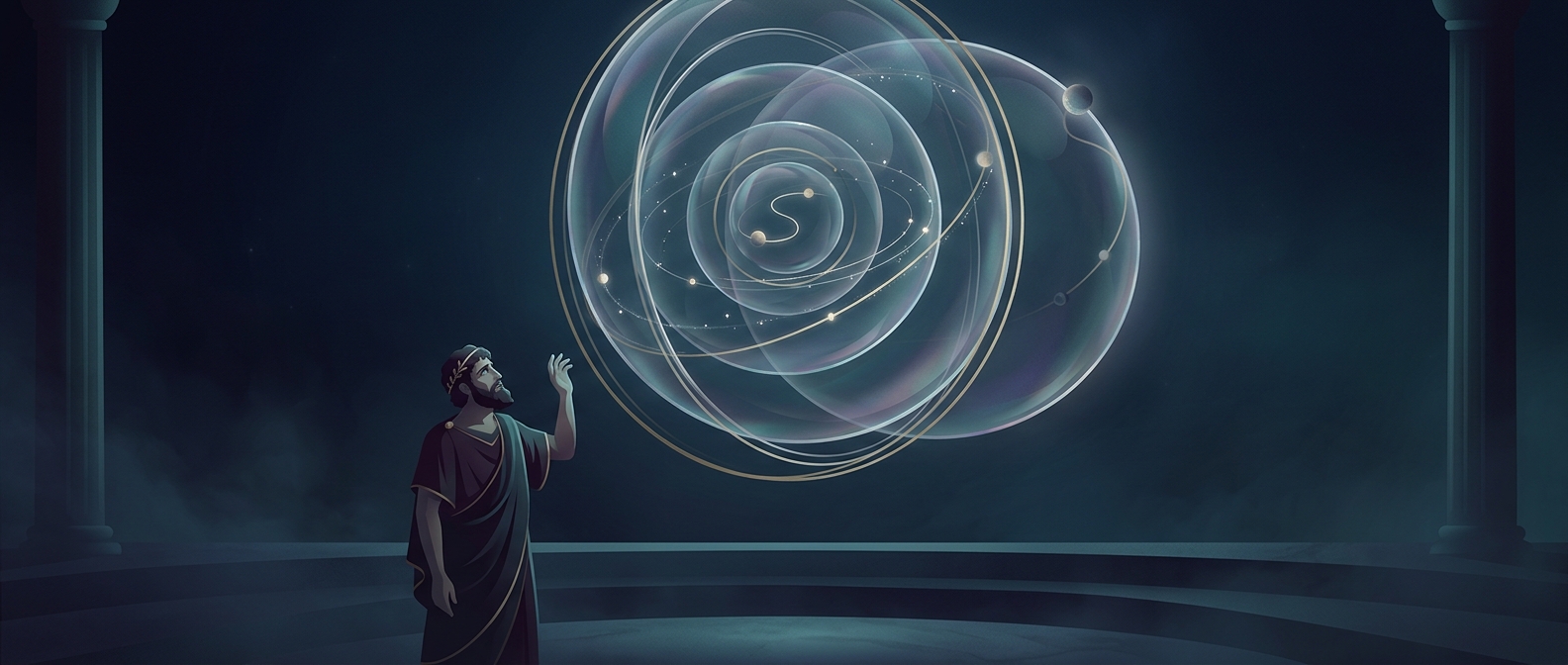
A geocentric model—one that places Earth at the center—had to account for that loop without making Earth move. Ptolemy’s system gave each planet two circular motions: a large path called a deferent and a smaller circle, the epicycle, whose center traveled along the deferent. The planet’s combined motion could trace the apparent backward arc while preserving the model’s commitment to circular movement around a stationary Earth.
The geometry was useful for predicting where planets would appear in the sky. It was also part of a wider ancient picture of the heavens as orderly and made of nested, rotating celestial spheres. But the epicycle was a mathematical device in the model; it is misleading to imagine every detail as a literal crystal mechanism. The important invention was a way to make the observed loop fit an Earth-centered cosmos.
A clever fit with a costly complication
As observations accumulated, the model could be adjusted with additional circles and refinements. That flexibility helped it remain useful, but also made the system intricate. Its history shows how a powerful model can explain puzzling observations on its own terms—even when the underlying picture of the universe is wrong.