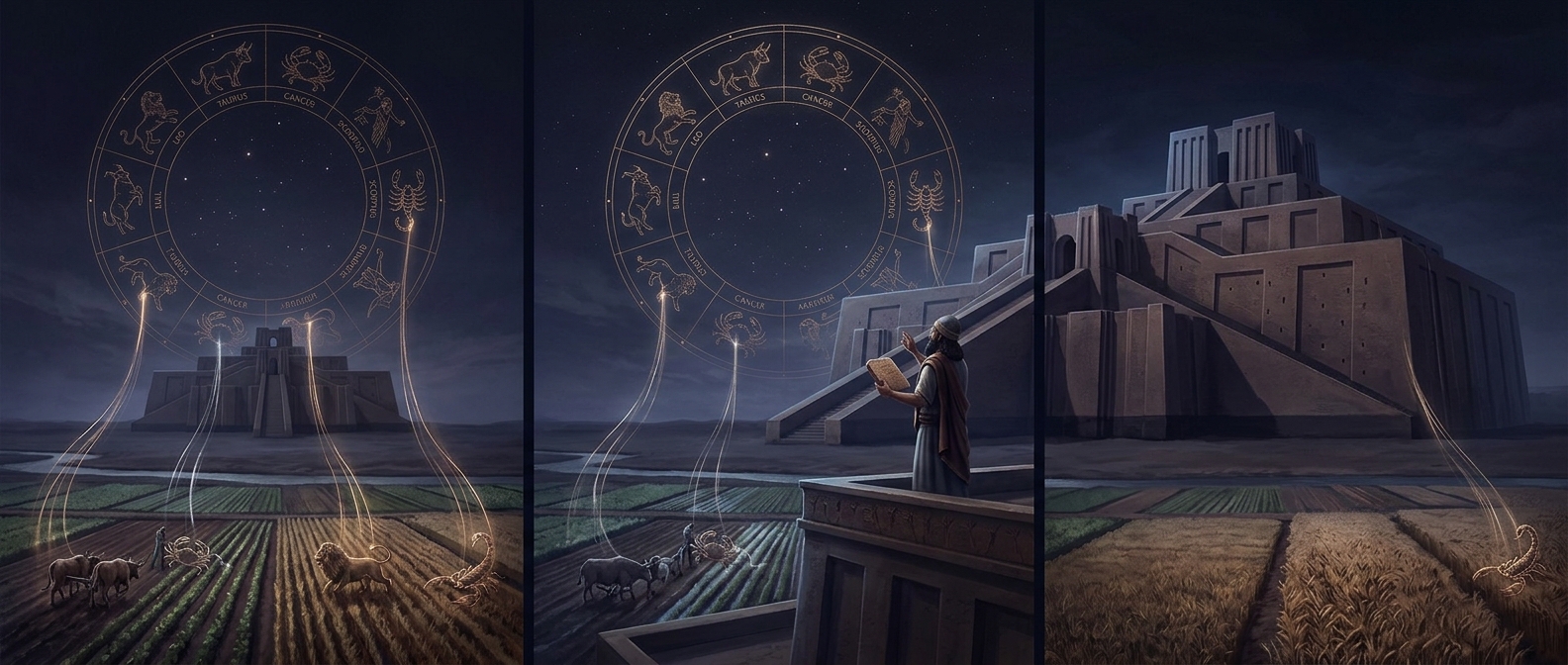
A sky calendar before a romance chart
The Babylonian zodiac began as a way to organize the Sun’s yearly path across the sky. Babylonian astronomers divided that path into twelve named sections, each associated with a month of the year. The system made recurring celestial patterns easier to record and compare with the calendar—and with the seasonal changes that mattered to farming communities.
That did not mean the zodiac was a precise planting schedule. Farmers still had to respond to local weather and conditions on the ground. But tracking the year through the sky offered a shared framework for anticipating seasonal transitions, including the timing of rains and river floods.
The original signs were not personality types
Babylonian sky-watchers also treated celestial events as omens: signs thought to carry messages about events on Earth. That was astrology, but it was not yet the familiar popular system of matching zodiac signs to romantic compatibility or fixed personality traits. Those associations developed in later traditions.
The distinction matters: the zodiac’s twelve-part structure came from observing and organizing the sky, not from designing a guide to love or character. Its earliest practical value lay in making the year legible—turning the Sun’s repeating route into a calendar that people could use to think about what season was coming next.