Why the planets seemed to meet three times
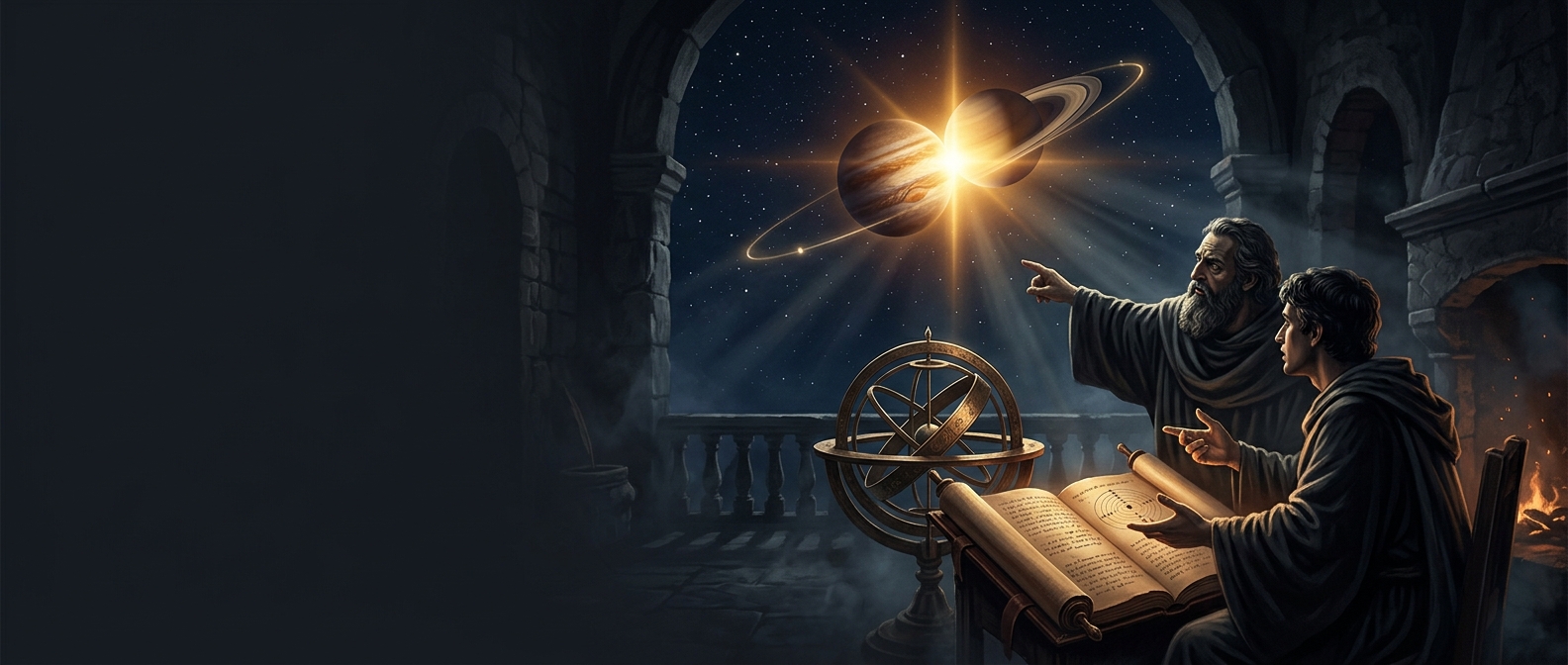
A conjunction occurs when two planets appear unusually close together in the sky. They are not physically near each other: Jupiter and Saturn remain far apart, but from Earth their positions line up along the same patch of sky. In 7 BC, they appeared to draw together in Pisces on three occasions over several months—a pattern called a triple conjunction.
The repeat happened because planets do not move across the sky at a steady pace from our viewpoint. As Earth and the outer planets travel around the Sun, Jupiter and Saturn can seem to slow, reverse direction, and move forward again. That apparent backward motion, called retrograde motion, can make a close pairing recur before the planets finally separate.
A sky event, and a question of meaning
For people who read the heavens as signs, a conspicuous planetary meeting could carry political or religious significance. Some modern interpreters have therefore proposed the triple conjunction as a natural event behind the Star of Bethlehem. But identifying a possible sky pattern does not establish that it was the star described in the Gospel accounts; the proposed connection remains one interpretation among others.
That distinction helps explain why the question mattered to Christian thinkers. If the star was an ordinary astronomical object, its appearance might be understood through the workings of the heavens. If it was a miracle, its significance did not depend on a predictable planetary mechanism. The debate was not simply about spotting two planets: it concerned whether a celestial sign could be both part of the natural order and a message about Christ.