When the Sky Served Two Kinds of Knowledge
For much of European history, studying the heavens meant asking two connected questions: How do celestial bodies move, and what might their positions mean for life on Earth? The first question belongs to astronomy; the second to astrology. They were not identical pursuits, but they shared observations, calculations, books, and sometimes the same working scholars. The modern boundary between “science” and “mysticism” had not yet hardened.
Astrology was more than reading personality from a birth chart. Rulers and physicians consulted forecasts, while practitioners used planetary positions to choose dates or interpret events. Producing a horoscope required mathematical work: a chart depended on calculating where the planets appeared in the sky at a particular time. Better astronomical tables therefore could serve both prediction and celestial research.
Galileo and Kepler Worked Across the Boundary
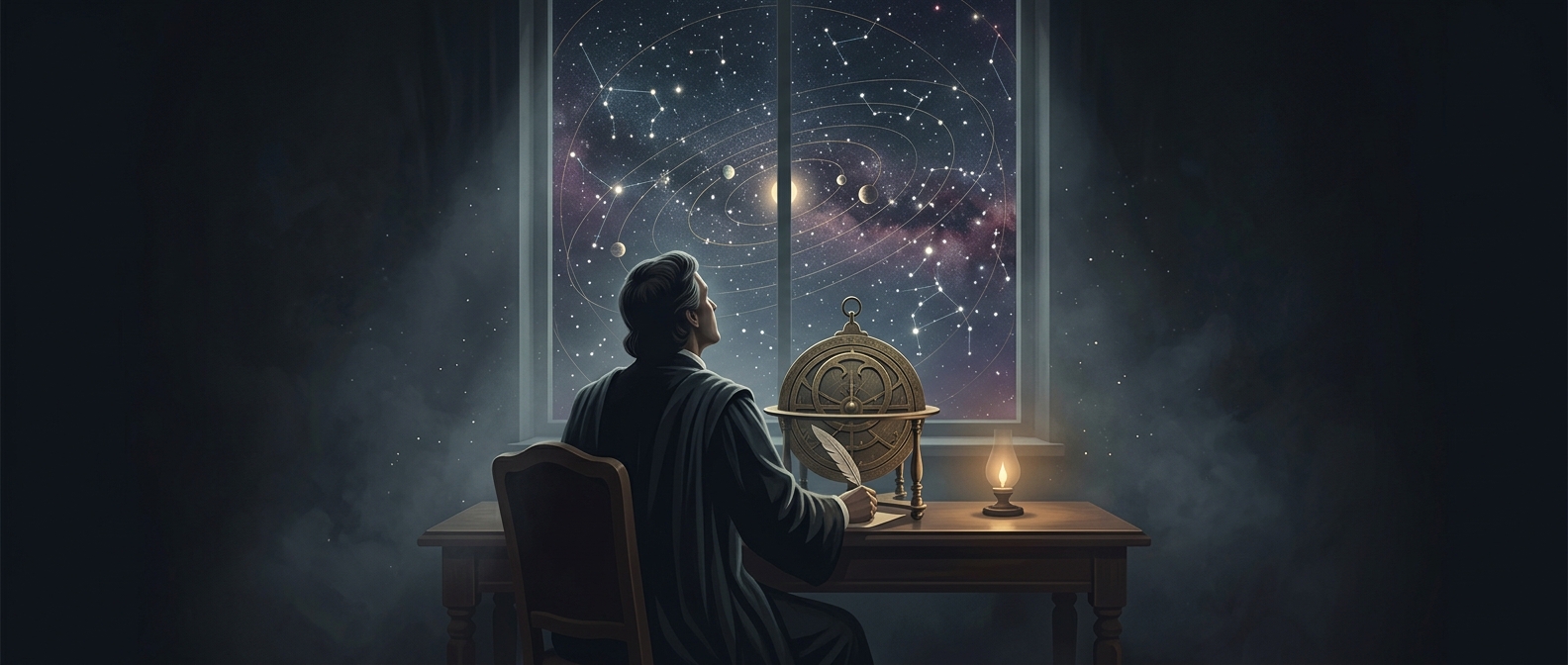
Galileo and Johannes Kepler are now remembered chiefly for transforming astronomy, but both also engaged in astrology. Kepler, in particular, prepared horoscopes and wrote about astrology, while arguing that its more defensible parts should be separated from unreliable claims. For scholars of their era, such work did not necessarily contradict serious study of planetary motion. The same person could calculate an orbit and interpret a chart, even while treating the two tasks with different degrees of confidence.
That overlap did not mean everyone considered every astrological claim sound. Skepticism existed long before the disciplines formally diverged. The change was that, over the seventeenth and eighteenth centuries, new standards for knowledge increasingly favored explanations that could be tested through observation and mathematical laws. Astronomy gained strength by explaining the motions of planets without relying on their supposed influence over human affairs. Astrology, whose predictions were harder to verify consistently, lost standing in scientific institutions.
A Boundary Built Gradually
The Enlightenment helped make that separation more explicit, but it was not a single break on a particular day. As universities, scientific societies, and educated readers drew sharper lines around what counted as reliable knowledge, astronomy became a distinct physical science and astrology moved outside that category. The striking legacy is that some of the same calculations once used to map the heavens and cast a horoscope helped build the astronomy that eventually no longer needed the horoscope at all.