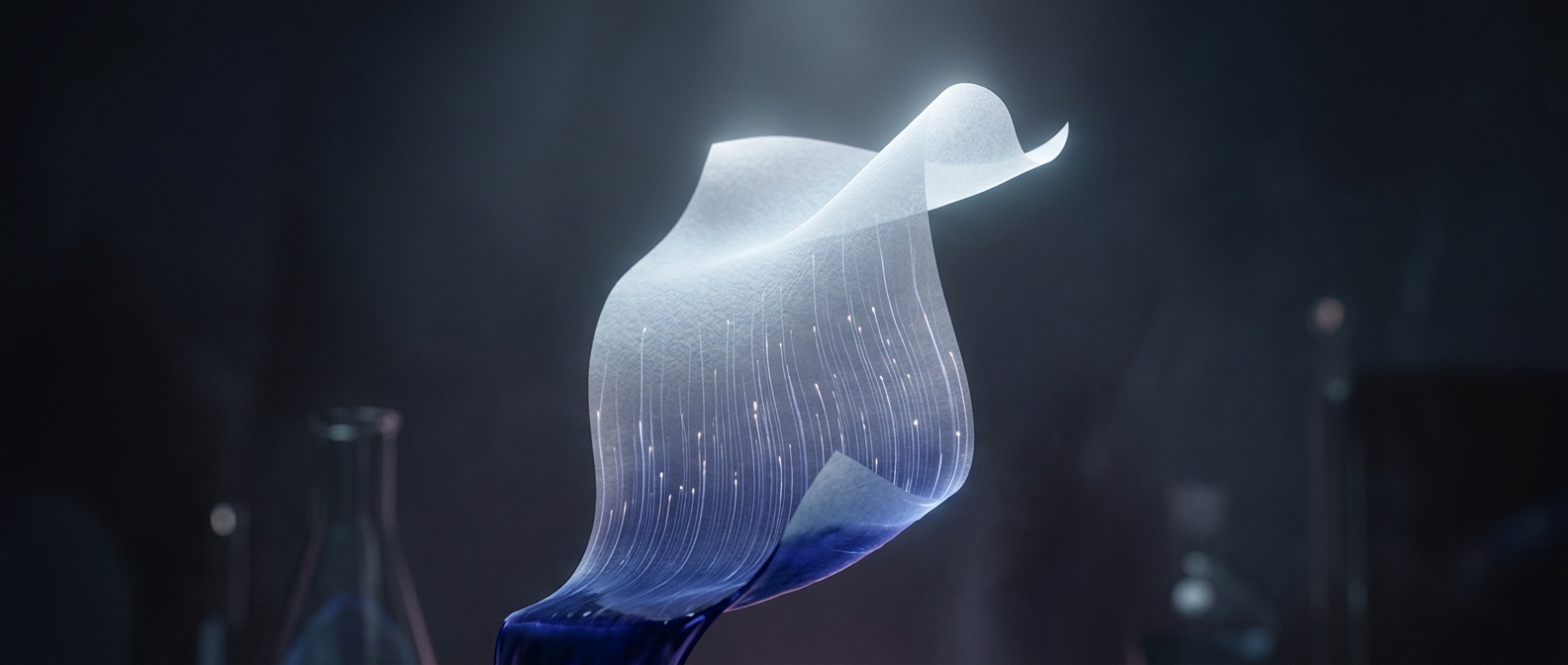
Why a Dry Towel Can Draw Water Upward
A paper towel is not a solid sheet so much as a tangled web of cellulose fibers, with countless tiny spaces between them. When an edge touches water, some of the liquid’s molecules are attracted to the fiber surfaces. This attraction is called adhesion. It pulls water into the narrow gaps, much as liquid can creep along the inside of a thin glass tube.
How the Wetting Front Keeps Moving
Water molecules also attract one another. As molecules at the wet edge cling to the fibers, they pull neighboring molecules along through cohesion. The moving boundary between wet and dry paper—the wetting front—can therefore advance through the towel’s pores without a pump.
The gaps matter: in narrow spaces, the attraction between water and the surrounding fibers has a strong influence on the liquid. Together, adhesion and cohesion create capillary action, the same basic effect that carries water through thin tubes and helps plants move water through some of their tissues.
Gravity Sets the Limit
Capillary action can lift water against gravity, but it does not provide unlimited upward motion. As the wetting front rises, gravity increasingly pulls the water back down. The climb stops when the upward capillary pull can no longer overcome the weight of the water column.
That is why a towel dipped at one end becomes wet beyond the point touching the water, but the wetness does not spread upward forever. The fibers provide the route; the tiny gaps and molecular attractions provide the pull.