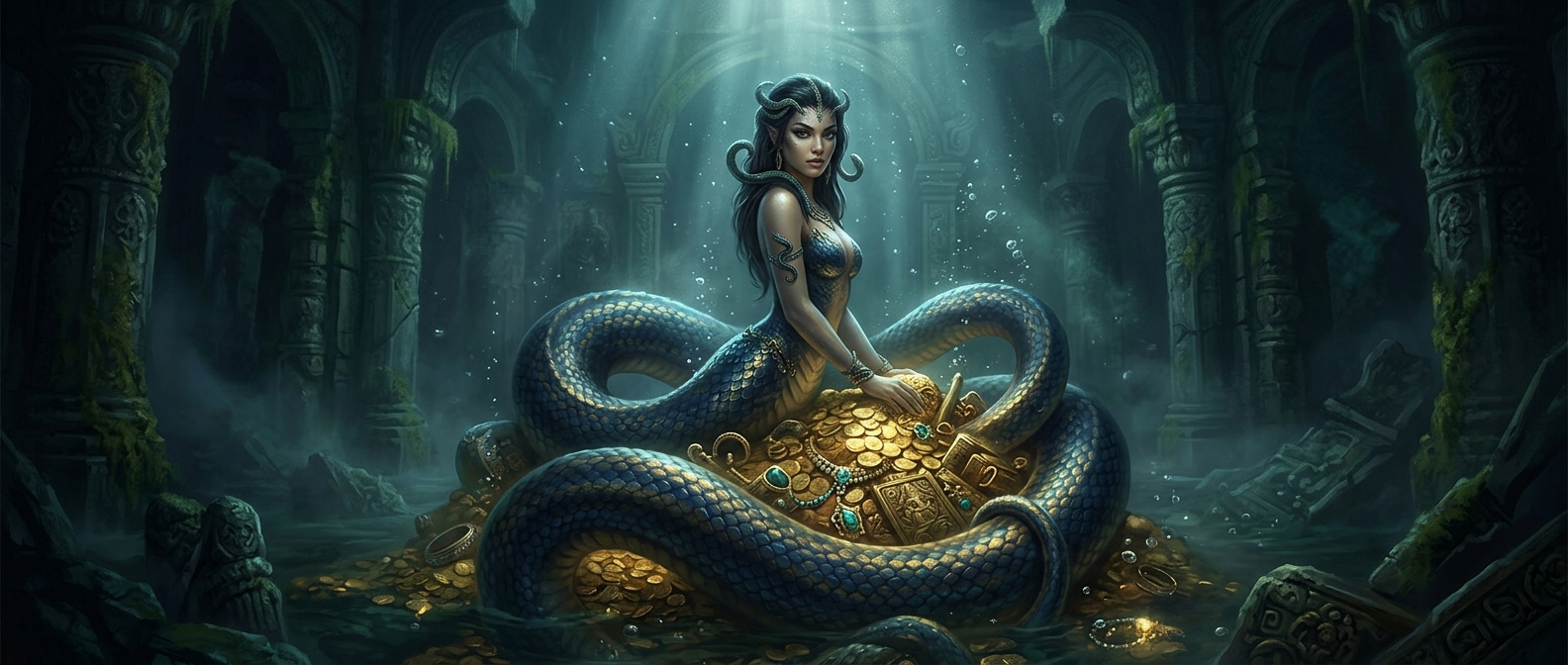
What a Naga Represents
Nagas are powerful serpent beings found in religious traditions and folklore across South and Southeast Asia. They may appear as snakes, as humans with cobra-like features, or in forms that combine the two. Their stories vary by region and tradition, so there is no single canonical account of what every naga looks like or guards.
The image of a naga protecting treasure gives the serpent a role beyond that of a monster: it marks something as valuable and not freely available. Gems hidden underground make a fitting charge for a being associated with watery depths and the world beneath the surface. In such tales, approaching the treasure is also a test of whether a person respects the boundary around it.
Guardians, Not Just Threats
A naga’s danger does not necessarily mean it is evil. In many traditions, nagas can be guardians or powerful beings whose favor matters; their behavior depends on the story and on how humans treat them. A person who tries to seize what is protected may face a bite, while respectful conduct can lead to a very different relationship.
That tension helps explain why serpent guardians recur in sacred stories and local legends: they embody both the attraction of hidden riches and the risk of taking what is not yours. The treasure is tempting, but the naga is the warning that access has a cost.