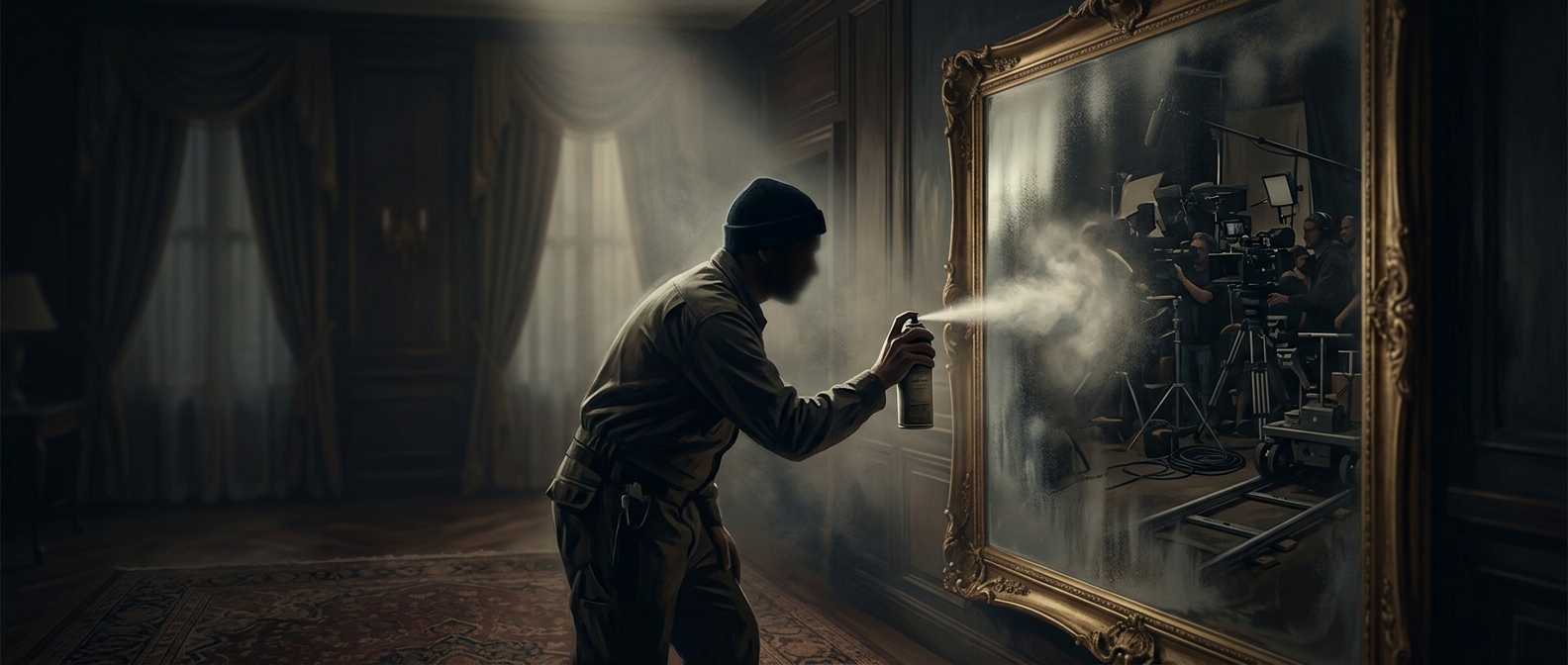
How a Clear Reflection Turns Cloudy
A mirror forms an image by bouncing light back in an orderly way: rays from each point in the room leave the surface at matching angles, preserving the scene’s shape. A matte coating disrupts that orderly bounce. Its fine texture scatters the reflected light in many directions, so the camera records a dull, blurred surface instead of a recognizable reflection.
The coating does not need to make the mirror dark. It changes how the light travels, much as a frosted window still lets light through but no longer gives a sharp view. That distinction matters on a set: the mirror can remain visibly present while ceasing to act like a second window into the room.
The Reflection Is Part of the Set
A mirror can accidentally show the camera, lights, or crew—especially when a shot must include both an actor and the reflective surface. Repositioning the camera may solve the problem, but it can also change the composition or make the scene harder to stage. Dulling the mirror gives the crew another way to control what the lens sees.
There is a tradeoff: once the coating scatters the light, the mirror cannot provide a crisp image for the scene either. If a clear reflection is essential, the filmmakers need a different setup or another way to create that image. The practical choice is simple but consequential: keep the mirror’s shape in frame, or keep its reflection.**