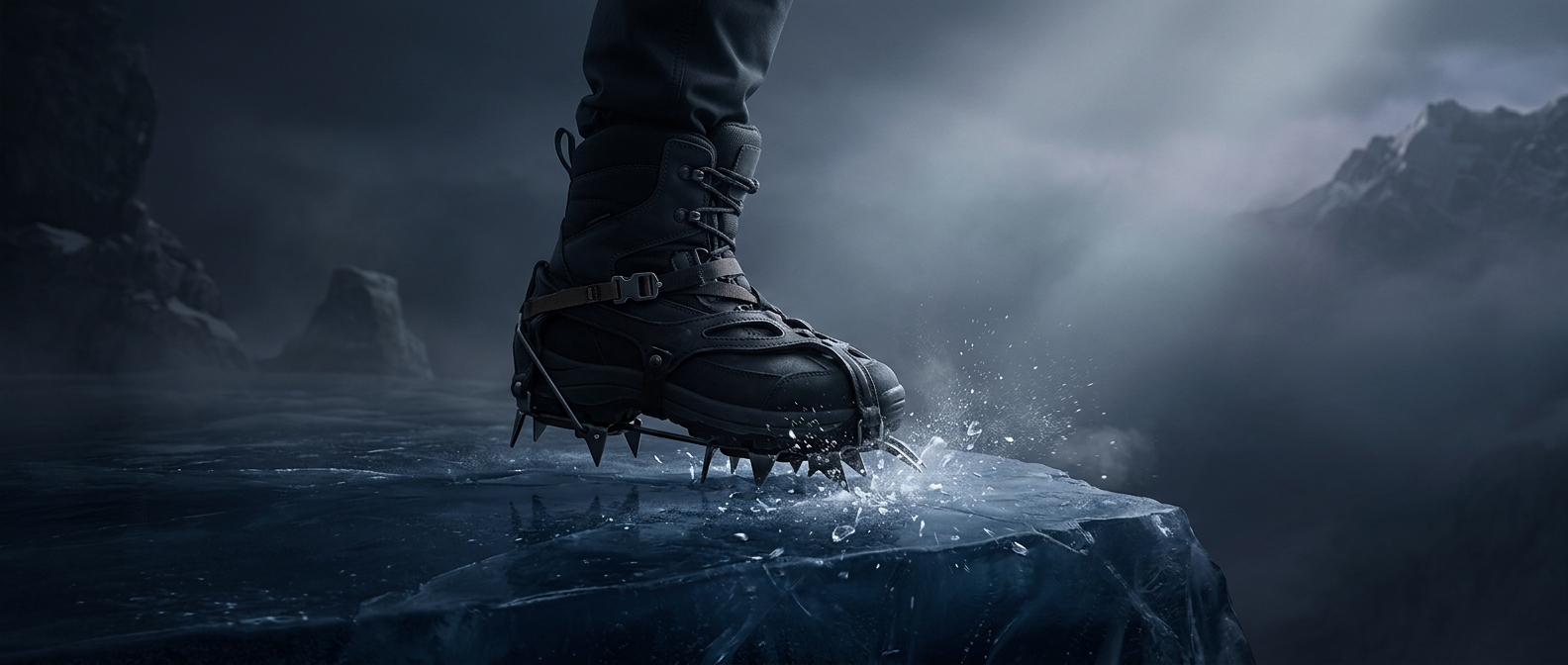
Why Points Work Better Than a Flat Sole
A boot sole relies on friction: its rubber presses against the ground, and the surface resists sliding. On hard ice, that resistance can be very low. Crampons change the contact. Their downward-facing metal points concentrate a person’s weight onto small areas, helping the tips bite into the ice rather than slide across its surface.
That concentrated pressure is the key. A broad sole spreads the same weight over a wide area; a point applies it locally, making it more likely to break through a thin slick layer or catch in small irregularities. Once several points engage, they help resist movement in more than one direction.
Grip Comes With a Change in How You Walk
Crampons are attached to the boot, so their points move with each step. The wearer has to place a foot deliberately and keep the points from catching on clothing, the other boot, or uneven ground. A rushed or poorly placed step can still lead to a fall: the gear improves the connection to the ice, but it does not make every surface predictable.
Point shape and placement also reflect a tradeoff. Points that project downward help on relatively level icy ground; other arrangements are intended to engage steeper or more varied terrain. The right configuration depends on where the boot must hold. In every case, the useful result is mechanical rather than magical: a sliding contact becomes a set of small, deliberate catches.