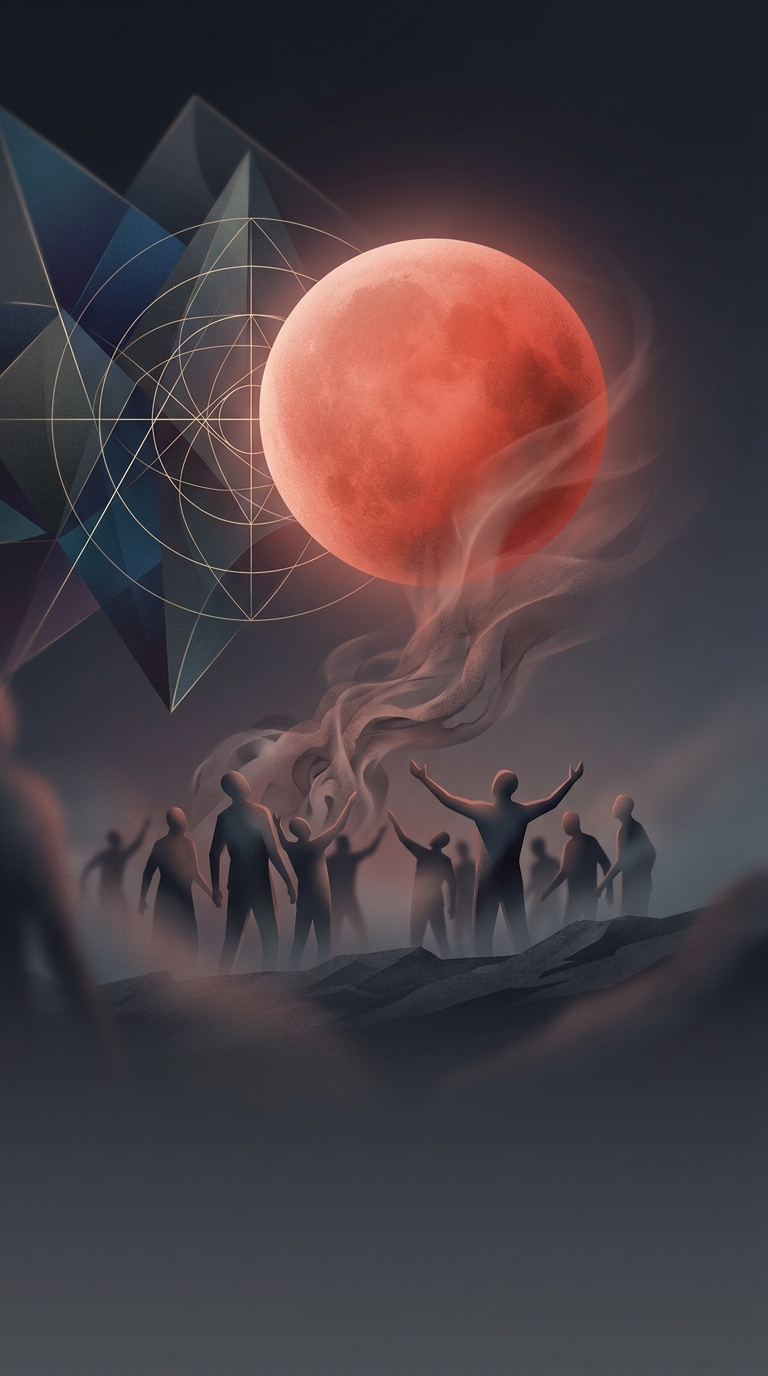
Why a red Moon invites a prophecy
A lunar eclipse turns a familiar, dependable landmark into something that can look strangely altered. That visual jolt helps explain why some spiritual and apocalyptic interpretations treat a blood-red Moon as a message: the sky seems to mark a break between ordinary life and a moment of upheaval. In such readings, the eclipse may stand for danger, judgment, renewal, or a shift into a new spiritual era.
Those meanings are interpretations, not properties astronomy assigns to the Moon. “Blood moon” is a popular expression rather than a separate kind of eclipse, and the shade can vary with conditions in Earth’s atmosphere. The same event can therefore carry different meanings in different belief systems.
A warning that can be prepared for
The striking color does not make an eclipse unpredictable. Its timing can be calculated from the motions of Earth and the Moon, so the event can be anticipated well in advance. For people who read it as an omen, that predictability can turn the eclipse into a focal point: a date to watch, reflect, or prepare for—not necessarily proof that a particular catastrophe will follow.
That distinction matters. A prophecy can shape how people understand an event even when the event itself has a physical explanation. The red Moon’s power as a symbol comes from the meaning people attach to its appearance, not from a demonstrated signal that civilization is about to collapse.