Why a planet can look as if it changes direction
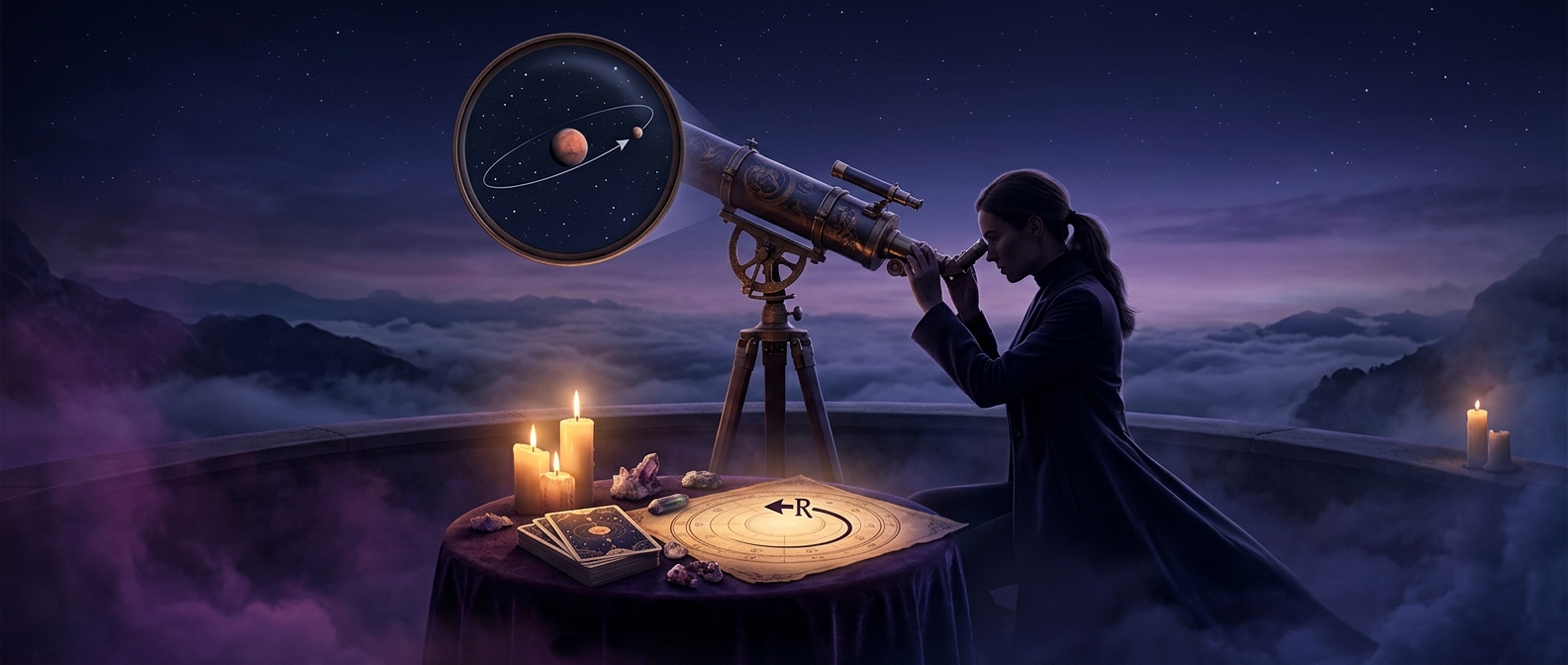
A planet’s position in the sky is measured against the distant stars behind it. Over most nights, planets drift gradually eastward against that starry backdrop. But their apparent path can briefly bend the other way—a period called retrograde motion. The planet itself keeps traveling forward along its orbit; what changes is our viewpoint.
Earth’s moving viewpoint creates the reversal
For Mars and the other planets farther from the Sun than Earth, the key moment comes as Earth catches up and passes them. Earth orbits closer to the Sun, so it completes a lap more quickly. During the pass, our changing position makes the outer planet seem to slide backward against the stars, much as a slower car can appear to drift backward when you overtake it. Once Earth has moved ahead, the planet resumes its usual apparent direction.
The effect is not just a quick flicker. Because the planets keep moving while Earth passes, the apparent reversal unfolds over weeks or months and traces a loop or shallow zigzag in the sky. The shape depends on the angle and timing of the two planets’ paths.
Mercury and Venus can also appear retrograde, but their geometry differs: because they orbit inside Earth’s orbit, their apparent reversal occurs as they pass between Earth and the Sun or move around the far side of the Sun from our perspective.
A sky pattern, not a change in a planet’s course
Astronomers can predict retrograde periods from the planets’ positions and orbital speeds. In astrology, retrograde periods are assigned symbolic meanings, but those interpretations are separate from the physical explanation: no planet turns around or reverses its orbit. The striking part is that a real, predictable change in our line of sight can make a steady forward journey look like a backward one.