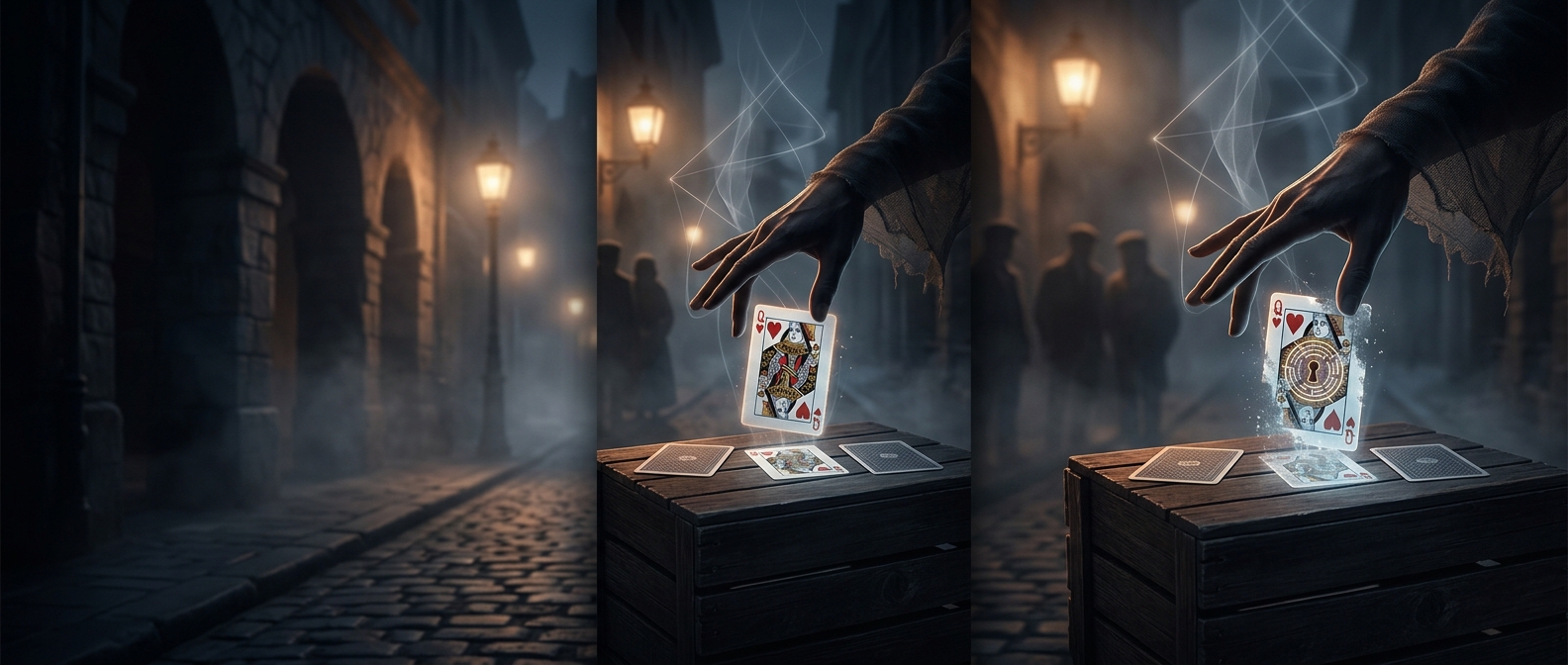
The card you follow may not be the card being played
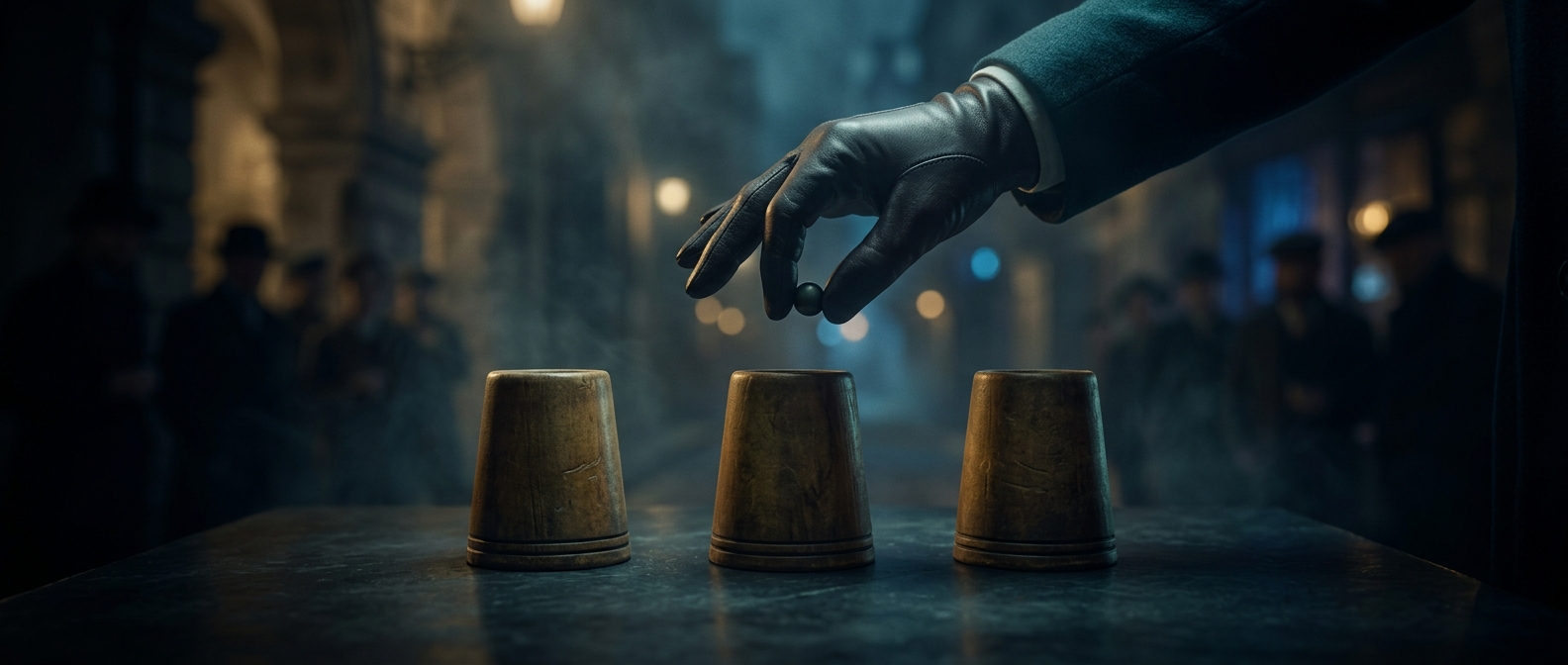
Three-card monte looks like a test of attention: watch the queen, track it through a few quick moves, then point to where it stopped. But the dealer’s hands are not simply shuffling three cards in a fair, repeatable pattern. Sleight of hand—concealed movements that make a card appear to go somewhere it did not—can change the queen’s position while preserving the impression that you watched it travel.
That gap between what seems to happen and what the hands actually do is the hustle’s central trick. A card may be shown clearly, then secretly held back or shifted during a movement that looks like an ordinary placement. The spectator follows the visible action; the dealer controls the hidden one.
Why watching harder does not solve it
The quick pace helps, but speed alone is not the point. The dealer gives your attention a plausible path to follow: a card is displayed, moved, and apparently left in a new spot. Your eyes can track that sequence while missing a small change in how the card is handled. Once the move is concealed, remembering the sequence accurately does not guarantee that you know where the queen is now.
The apparent fairness is part of the setup. The cards are visible, the movements seem simple, and the target appears to be within reach of careful observation. That makes a loss feel like a personal mistake—and can tempt someone to bet again to prove they can track the cards.
The game is built around control, not prediction
In an honest tracking game, the player’s task would be to follow a card whose position changes openly. In monte, the dealer can manipulate the very information the player relies on. The spectator is not merely trying to guess among three locations; they are trying to infer a hidden move from a performance designed to disguise it.
That is why the game is called a hustle rather than a fair test of eyesight. If the target card’s location is under the dealer’s control, watching more intensely cannot make the contest even.