Why a Mirror Makes a Room Behind the Glass
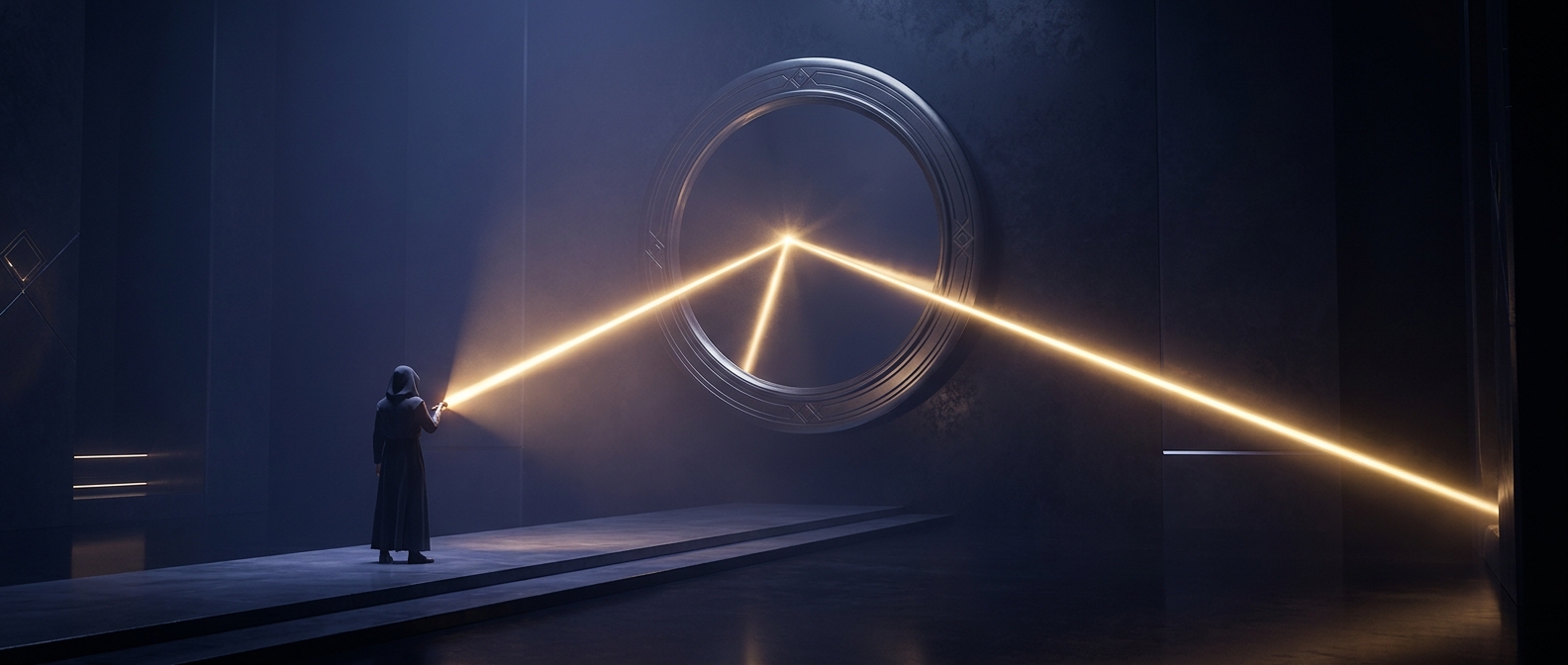
The “same angle” is measured from an imaginary line perpendicular to the mirror, called the normal. A smooth mirror sends each ray away at the angle it arrived. Rays from one point on an object therefore reach your eyes in an orderly pattern that preserves the object’s shape and position relative to other objects.
Your eyes and brain ordinarily assume light traveled in straight lines. Extend the reflected rays backward, and they appear to meet at a point behind the mirror. For a flat mirror, that apparent point lies as far behind the glass as the object is in front of it. The rays do not actually meet there: the image is virtual, meaning it can be seen but cannot be projected onto a screen placed behind the mirror.
Why Polished Surfaces Show Images
A mirror works because its reflective surface is smooth on a scale much smaller than the light’s wavelength. The surface sends rays in consistent directions, so the light from neighboring points stays organized enough to form a recognizable image. A rough wall also reflects light, but its tiny irregularities scatter rays in many directions. That scattered light lets you see the wall from different positions, while scrambling the pattern needed for a reflection.
This is why even a small distortion in a mirror’s shape can change what it shows: the surface redirects the rays, shifting where your brain places the apparent image. The room seems to continue behind the glass, but every visible detail is built from light that has already bounced off its surface.