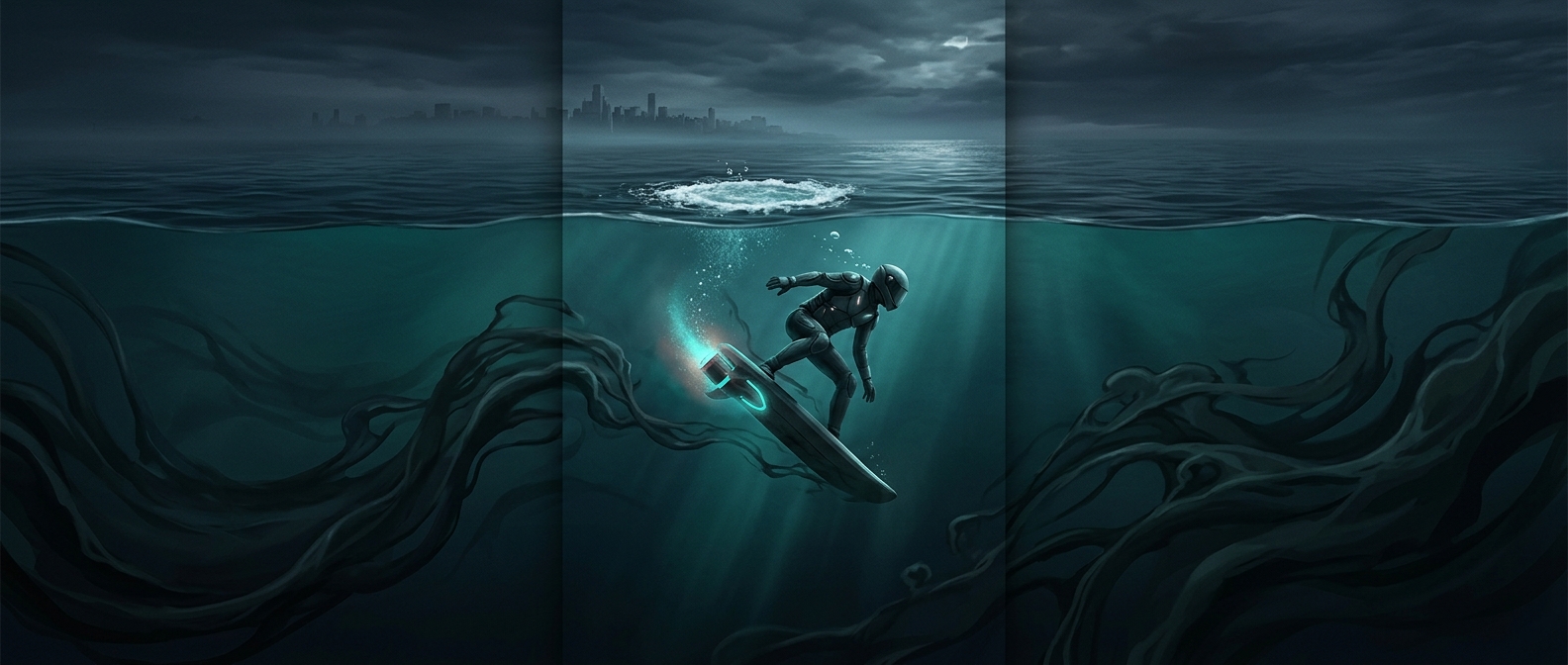
The foil turns forward motion into lift
A hydrofoil is a small, wing-shaped surface mounted under a board. As the board moves, water flows around the foil. Its shape and angle redirect that water, creating an upward force that can raise the board and rider above the surface. The board is not floating higher because the water beneath it has become a cushion; it is being supported by the moving water acting on the foil.
This lift grows with speed. Once it is strong enough to carry the rider’s weight, the board rides on the foil rather than pushing its full underside through the water. With less board in contact with the water, drag—the force resisting forward motion—falls, making the ride feel smoother and faster.
When speed fades, support fades too
The foil does not keep lifting the board on its own. It needs water to keep flowing past it. Slow down, and that flow weakens; stop, and the foil’s dynamic lift disappears. The board then settles onto the water, where ordinary buoyancy supports it, much like a conventional board.
That change happens because gravity never stopped pulling the rider and board downward. While the board is moving, the foil’s lift balances much of that downward force. When the lift ebbs, gravity wins and the board drops back to the surface.
Speed is part of the ride—and its limit
A hydrofoil ride therefore depends on maintaining enough motion to stay elevated. Turns, waves, or reduced power can cost speed and lower the board; the rider must manage acceleration and balance to regain the foil’s lift. The striking tradeoff is that the board feels freed from the water only while it keeps moving through it.