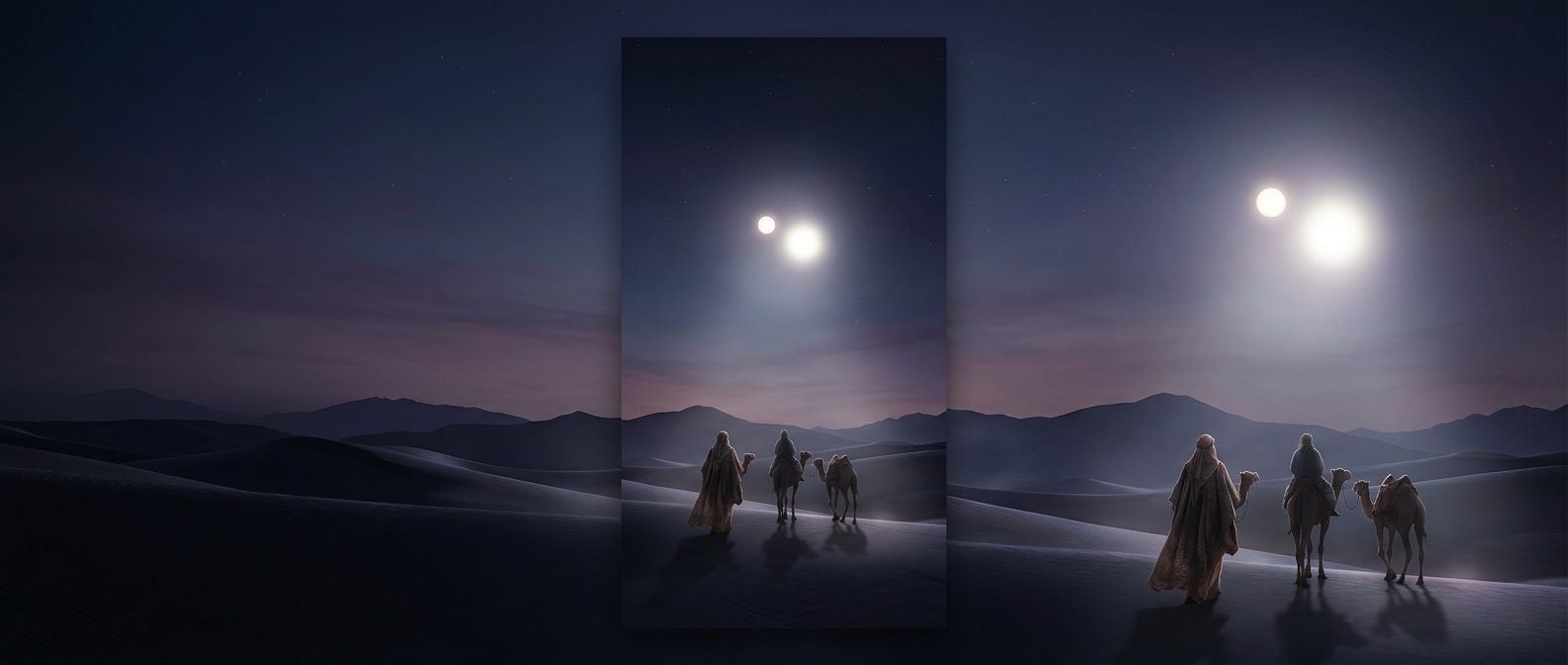
How two planets can seem to become one
A conjunction happens when two celestial objects appear close together in the sky from Earth. Venus and Jupiter do not actually meet: they orbit at very different distances from the Sun. Their alignment merely places them along nearly the same line of sight, so the gap between them can look tiny to someone watching from the ground.
Both planets are bright enough to stand out even in a twilight sky. If they appear especially close, the eye may register them as a single striking point of light. That visual effect offers a possible explanation for why an unusual sky event could be remembered and described as one star.
Why the alignment could carry meaning
In the ancient world, unusual planetary appearances were often read astrologically—as signs that might speak to events on Earth. Under that way of thinking, the conjunction would not need to be a new star; its rarity and brilliance could make it seem significant. The interpretation depends on the beliefs of the people observing it, not on the planets sending a message in a scientific sense.
The proposed 2 BC conjunction is therefore a candidate for the Star of Bethlehem, not a confirmed match. It offers a plausible mechanism for a memorable light in the sky, while leaving open whether that event was the one behind the story. The key distinction is that the planets could have looked fused to observers without ever physically coming together.