How an endless boundary can enclose finite area
The Koch snowflake starts with an equilateral triangle. At each step, the middle third of every edge is replaced by two sides of a small outward-pointing triangle. Each old edge therefore becomes four new edges, each one-third its length.
That rule has two different consequences. The total edge length is multiplied by \(4/3\) at every round, so it grows without bound. The shape itself, however, expands only by adding small triangular bumps.
Why the added area stays limited
At the first round, the bumps have side length one-third of the original triangle’s side. At the next, their sides are one-third as long again. Because a triangle’s area scales with the square of its side length, each new bump is only one-ninth the area of a bump from the previous round.
There are more bumps each time, but their combined area still shrinks: the number of bumps grows by a factor of four, while each bump’s area falls by a factor of nine. The added area at each round is thus smaller than at the one before. These additions form a converging geometric series—a sum that approaches a finite limit—so the snowflake’s area never grows beyond a fixed bound.
An infinite edge around a bounded patch
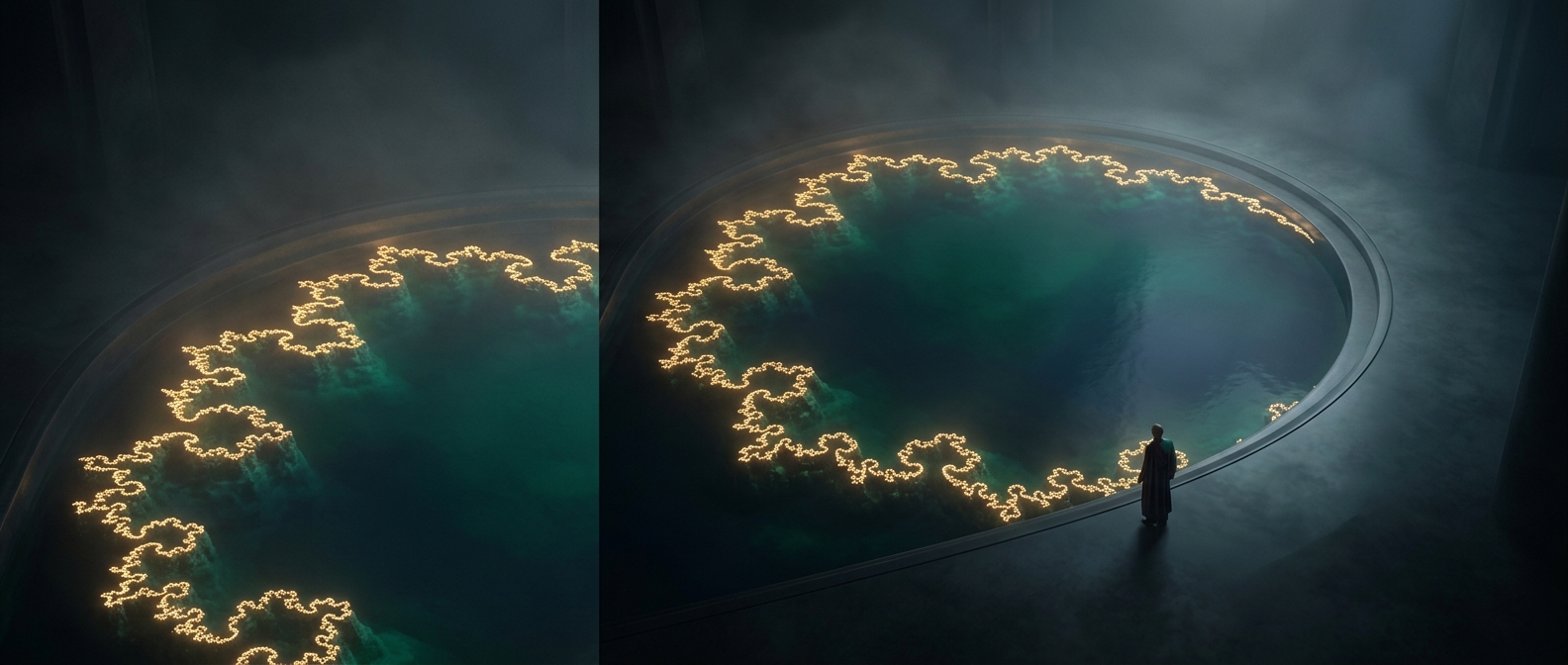
This is not a contradiction. Perimeter measures the length of the boundary, while area measures the region inside it; the two need not grow together when a boundary becomes increasingly intricate. In the ideal mathematical construction, the snowflake’s perimeter keeps increasing without limit, but its area approaches a finite value.
The striking result is that the boundary can become endlessly long without the shape spreading endlessly across the plane: however detailed the edge becomes, the snowflake remains within a bounded region.