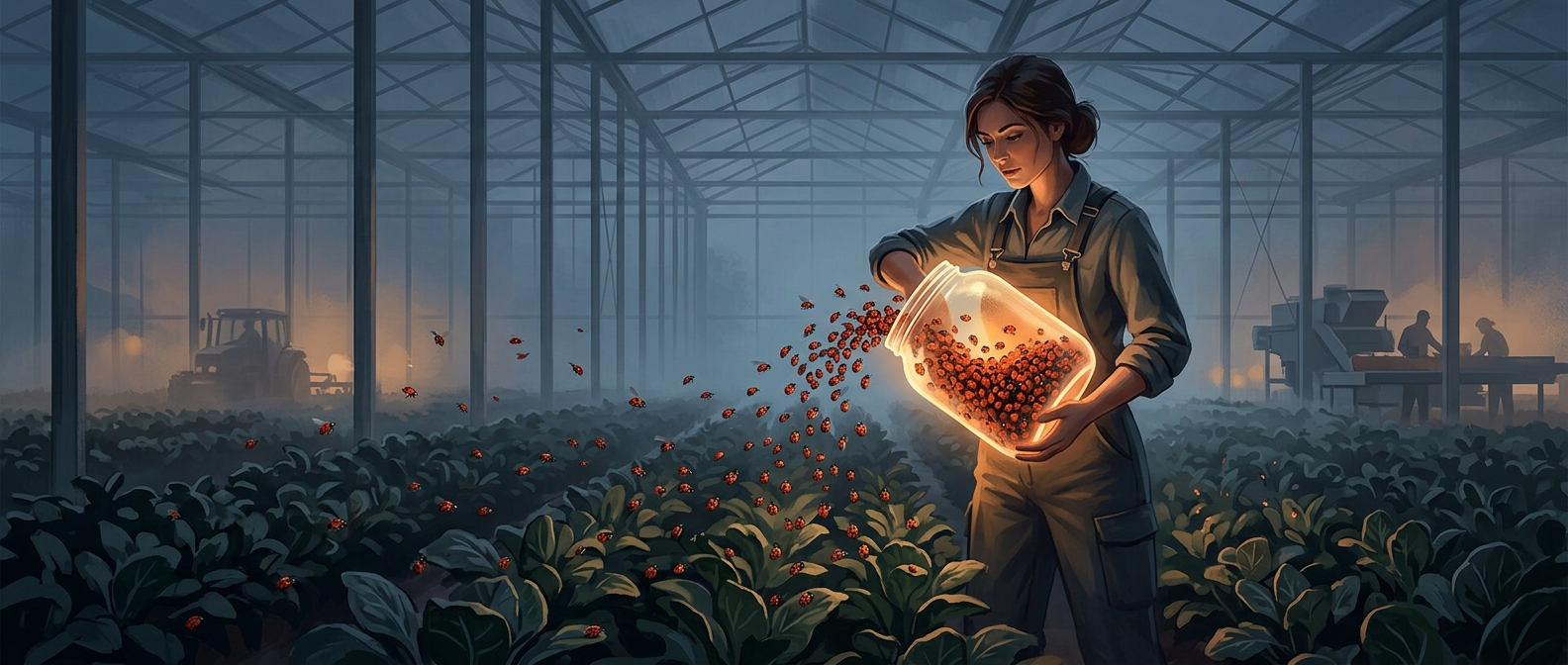
Why a Gallon of Beetles Can Be a Farm Input
Aphids are small, sap-feeding insects that gather on crops and can weaken plants as they feed. Ladybugs—more precisely, lady beetles—hunt aphids, so releasing them adds a predator to the field instead of relying only on a spray to kill pests.
The gallon is a practical way to sell a large number of live insects, not a measure of how much pest control a farm will get. How useful a release is depends on whether the beetles find prey and remain where they are needed.
The Catch: Predators Can Leave
Ladybugs are mobile. If released when aphids are scarce, or in a place that offers little reason to stay, many may fly off before they can eat many pests. A farmer therefore has to match the release to the crop and the infestation: the beetles need prey to find, and the pests need to be in a place the predators can reach.
That makes biological control different from applying a chemical treatment. A spray can cover a crop directly; live predators must locate their food and keep feeding. Their impact unfolds through that interaction rather than in a single pass.
A Tradeoff, Not a Simple Swap
Buying ladybugs turns pest control into a managed relationship between predator, pest, and crop. It can reduce the need for chemical spraying, but it does not make timing or monitoring irrelevant. Farmers still have to watch for aphids and judge whether enough beetles are staying and feeding.
The striking part is that the “gallon” is only the delivery unit. The real measure of success is whether those beetles remain in the crop long enough to find—and eat—the aphids.