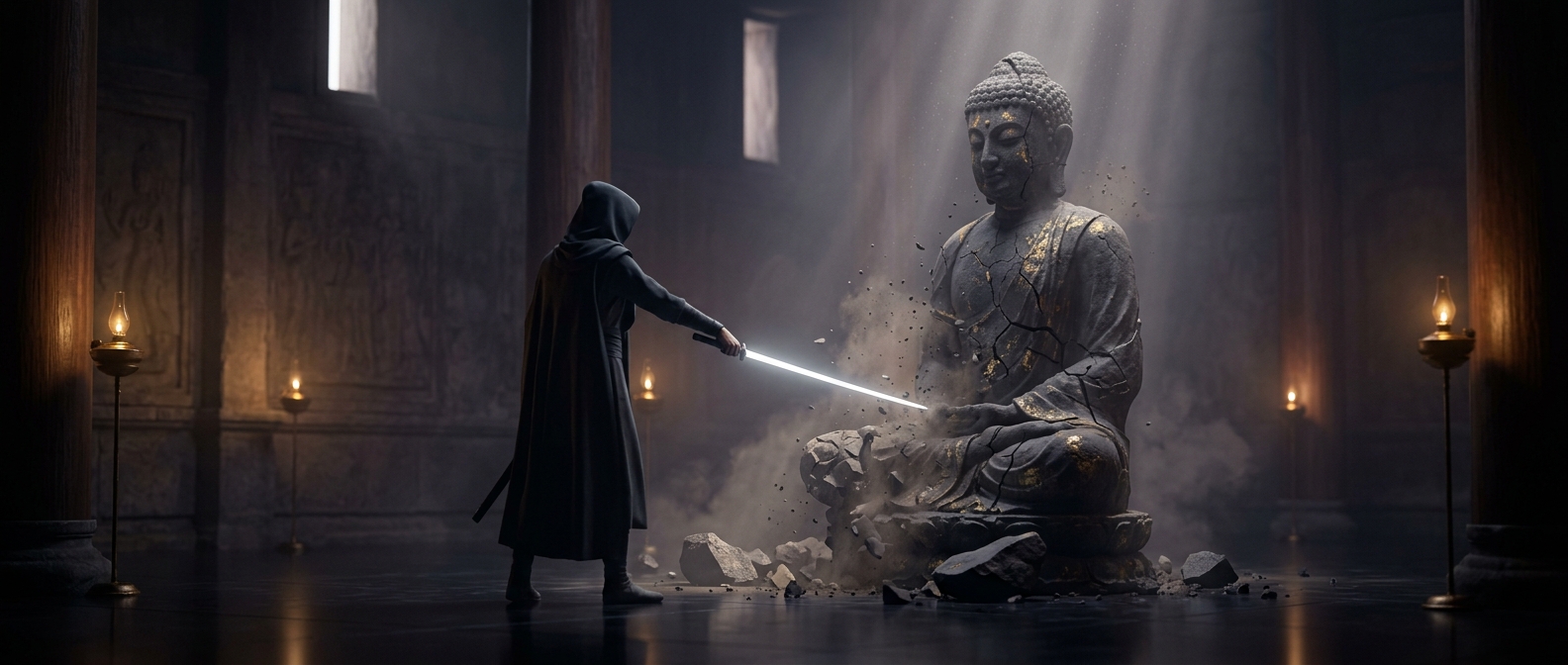
Why a Zen koan tells you to “kill the Buddha”
The line is meant to unsettle, not to authorize violence. In Zen practice, “Buddha” can stand for the truth a practitioner hopes to reach—or for a mental picture of what that truth must look like. The warning is that clinging to the picture can become an obstacle of its own.
A person may imagine awakening as a special feeling, a perfect teacher, or a final answer hidden in a sacred phrase. Those expectations can shape every experience in advance: instead of meeting what is happening, the person judges whether it matches the image. The koan’s deliberately shocking language presses on that habit.
The point is not to replace one idol with another
A koan is a brief story, question, or exchange used in Zen training. It is not simply a puzzle with a clever solution. A teacher may ask a student to work with a koan over time, bringing the question into meditation and daily life rather than solving it by ordinary logic alone.
That does not mean words, teachers, or Buddhist teachings are worthless. It means they are guides, not objects to cling to as if possessing the right phrase or venerating the right image were the same as understanding. Even the instruction to “kill the Buddha” would miss its purpose if treated as a new doctrine to repeat unquestioningly.
The koan’s force comes from turning a familiar act of reverence into a test of attachment. It asks whether a seeker can let go of the idea of truth long enough to encounter experience without forcing it to fit a cherished image.