Why Tetris Worked in Orbit
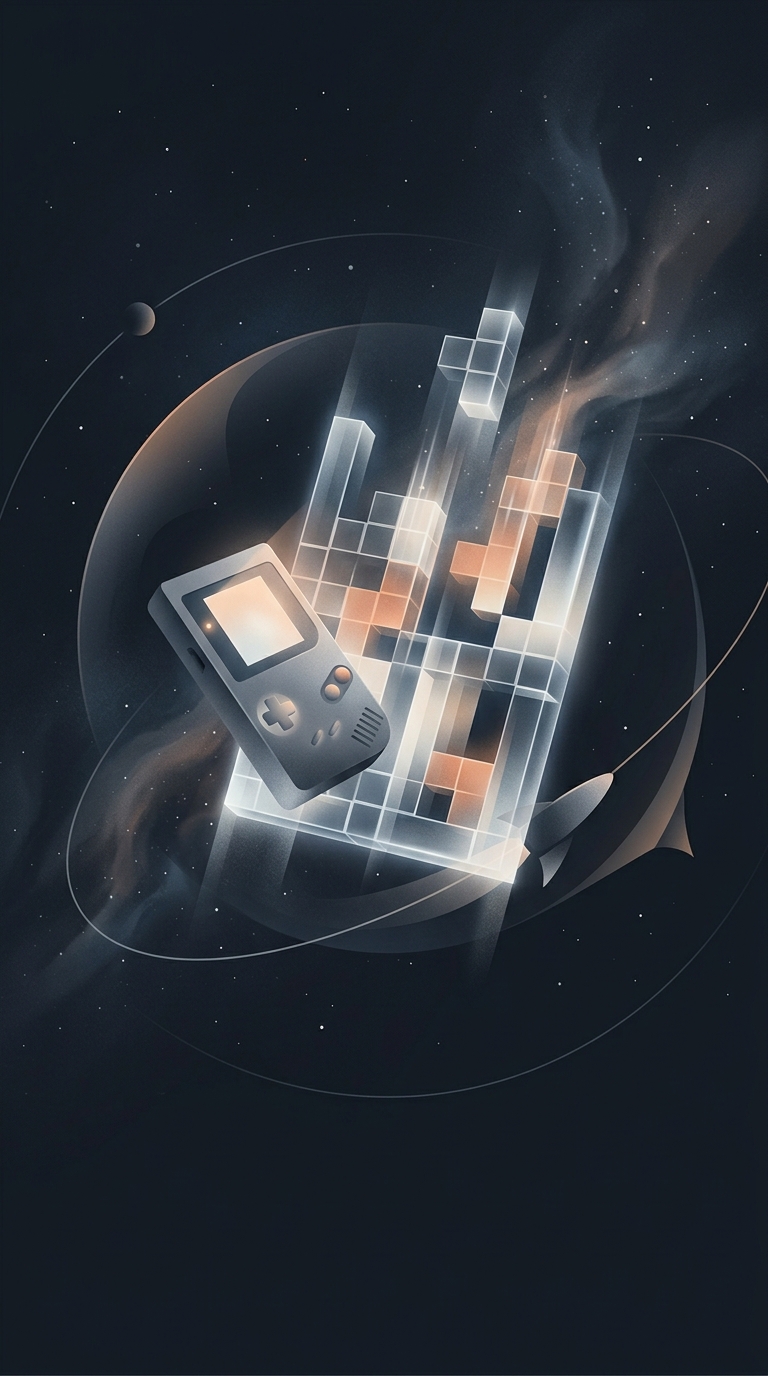
A handheld game needs little more than a screen, a few controls, and a player’s attention. That made the Game Boy unusually practical for spaceflight: it did not need a television, a console setup, or a surface on which to stay put. In microgravity, loose objects can drift, but a device held in the player’s hands remains usable.
Tetris was an especially natural fit. Its pieces fall toward the bottom of the screen according to the game’s own rules—not because of Earth’s gravity—so the player does not need a physical floor or a sense of “down” in the spacecraft. The challenge is to rotate and position each shape before the stack reaches the top. The game’s world supplies its own gravity, independent of the spacecraft’s motion.
A Handheld Along for a Long Mission
Serebrov’s Game Boy traveled with him on the Soyuz TM-17 mission and remained in orbit for 196 days. That duration describes the device’s time in space, not an uninterrupted gaming session. A small, self-contained game could offer a familiar pastime without requiring a larger entertainment setup, though the available facts do not establish how often it was played.
The episode also shows how a design built for ordinary portability could cross into an extraordinary setting. Tetris did not need to be redesigned for weightlessness: its essential rules already existed entirely on the screen. The Game Boy’s long orbital trip turned that simple separation between a game’s simulated world and the player’s physical surroundings into a memorable first for video games.