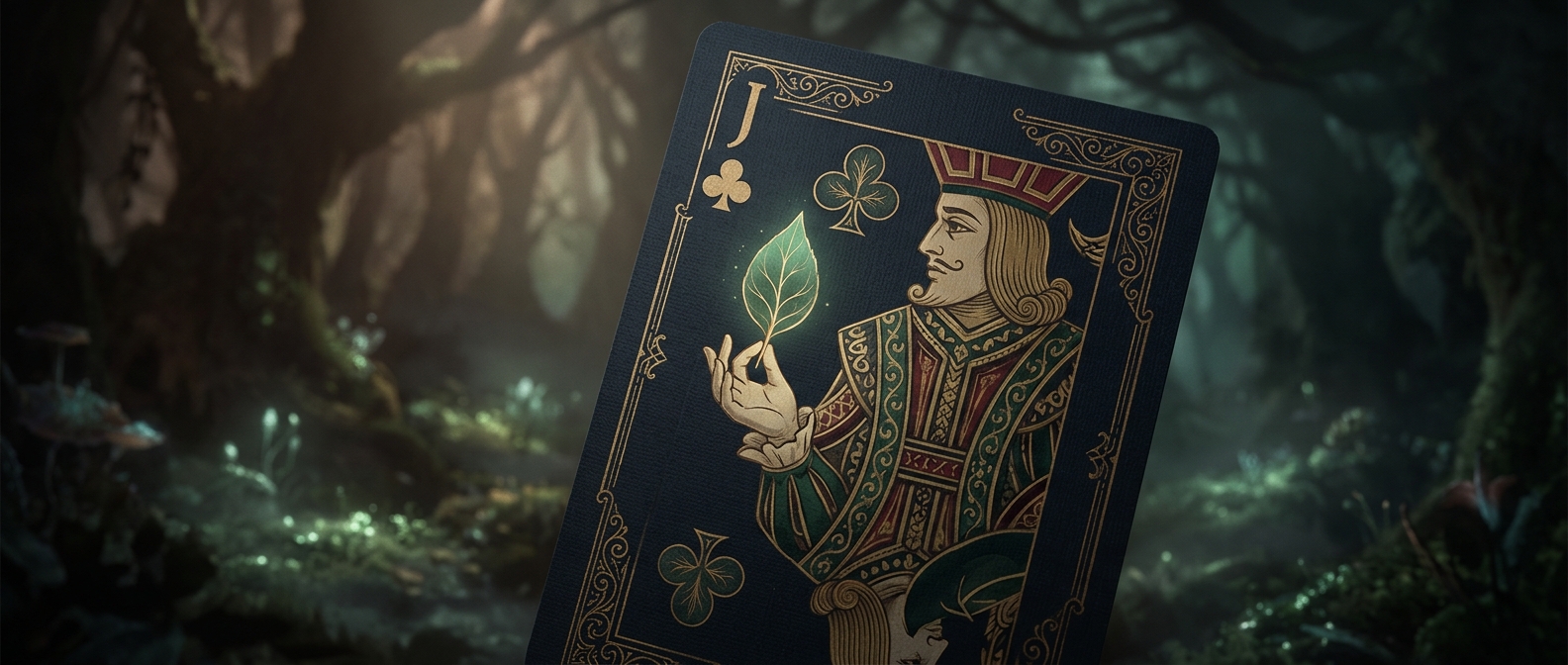
Why the Jack’s Object Can Read as a Leaf
On a playing card, a small object has to carry its meaning through a few printed lines. The Jack of Clubs’ hand-held shape may be intended to suggest a weapon or staff, yet its pointed outline and curved edges can make it look botanical instead. At card size, the eye often recognizes the silhouette before it can parse the details.
That ambiguity is reinforced by the court-card style. These figures are built from compact, decorative shapes rather than carefully observed scenes: clothing, hands, and objects overlap, and colored outlines do much of the work. A feature that might be clear in a larger drawing can become an uncertain wedge or leaf-like form when printed on a card.
A Design That Leaves Room for Interpretation
Court-card pictures also come in different patterns and editions, so there is no single drawing that every Jack of Clubs must match. Many modern designs descend from older European card patterns, but makers have altered details over time. The object’s appearance can therefore depend on the particular deck as well as on how the image is read.
The result is a small visual puzzle hiding in plain sight: the card gives the object a role through its pose, but its outline can suggest something entirely different. Once the leaf-like shape catches your eye, it can be hard to see the Jack’s hand-held object the same way again.