One Shoe Business Becomes Two Brands
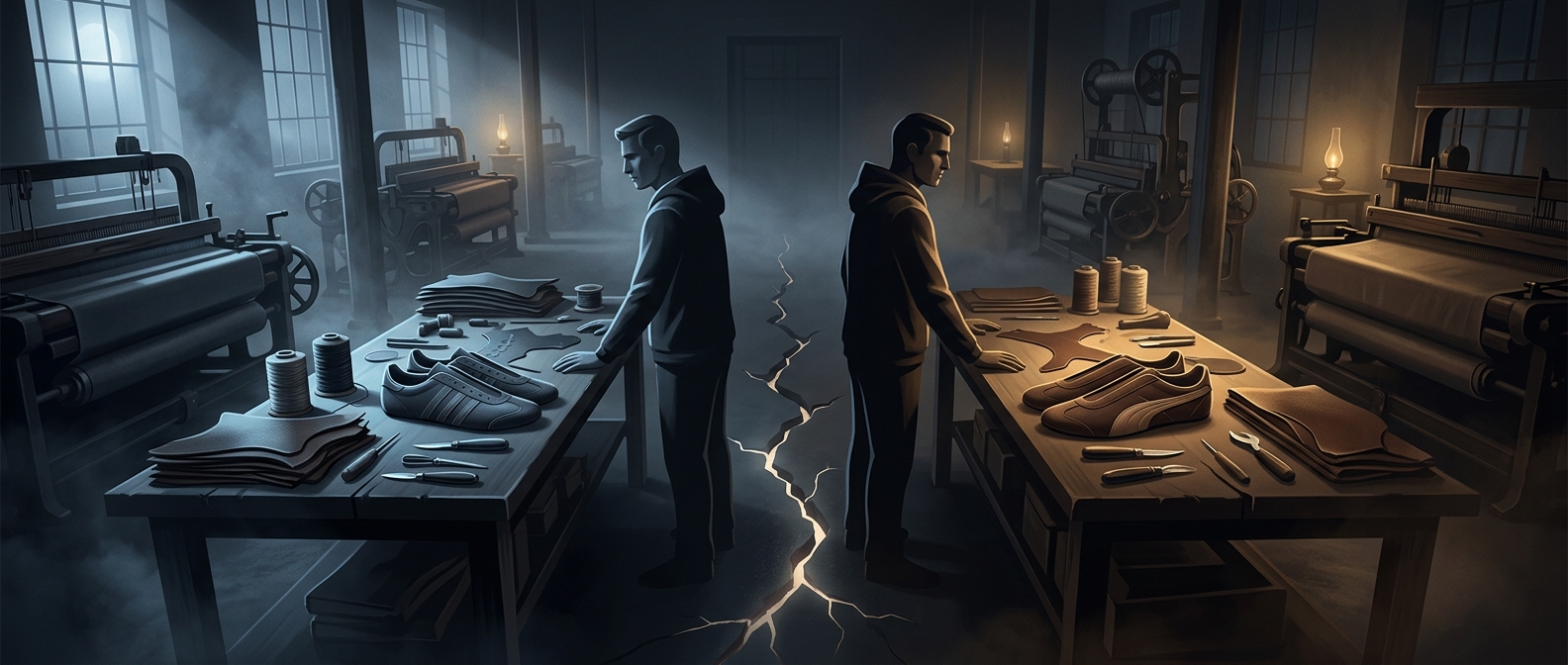
Before Adidas and Puma were rivals, they were one family business. Brothers Adolf and Rudolf Dassler made athletic shoes together in the Bavarian town of Herzogenaurach. After their partnership broke apart in 1948, each brother set up his own company: Adolf’s became Adidas, a name built from “Adi” and “Dassler,” while Rudolf’s became Puma.
The exact causes of the brothers’ feud have been described in different ways. What matters for the companies’ history is that the split divided not only ownership but also the people and expertise gathered around the shoe works. Instead of competing under one roof, the brothers now had to build separate businesses—and prove their shoes could stand on their own.
A Rivalry the Town Could See
The companies remained in Herzogenaurach, so the family conflict became part of daily life. Residents worked for one firm or the other, and the two employers competed for local labor as well as customers. The town’s reputation for taking sides grew alongside the brands; even ordinary choices could signal which company a person supported.
That local rivalry gave the companies a powerful setting for competition. Each had a reason to distinguish its products and identity from the other’s, while athletes and sporting events offered a public stage on which performance could be judged. A dispute between two brothers had become a contest between two names visible far beyond their hometown.
The Split’s Lasting Consequence
The feud did not simply produce two labels for similar shoes. It created two independent companies, each able to develop its own products, marketing, and sporting relationships. Adidas and Puma eventually became international brands, carrying the old family division into shops and stadiums around the world.
In Herzogenaurach, the rivalry began as a split in one workplace and one family. Its enduring oddity is that a private break became a public choice: for generations, people could literally wear one side or the other.