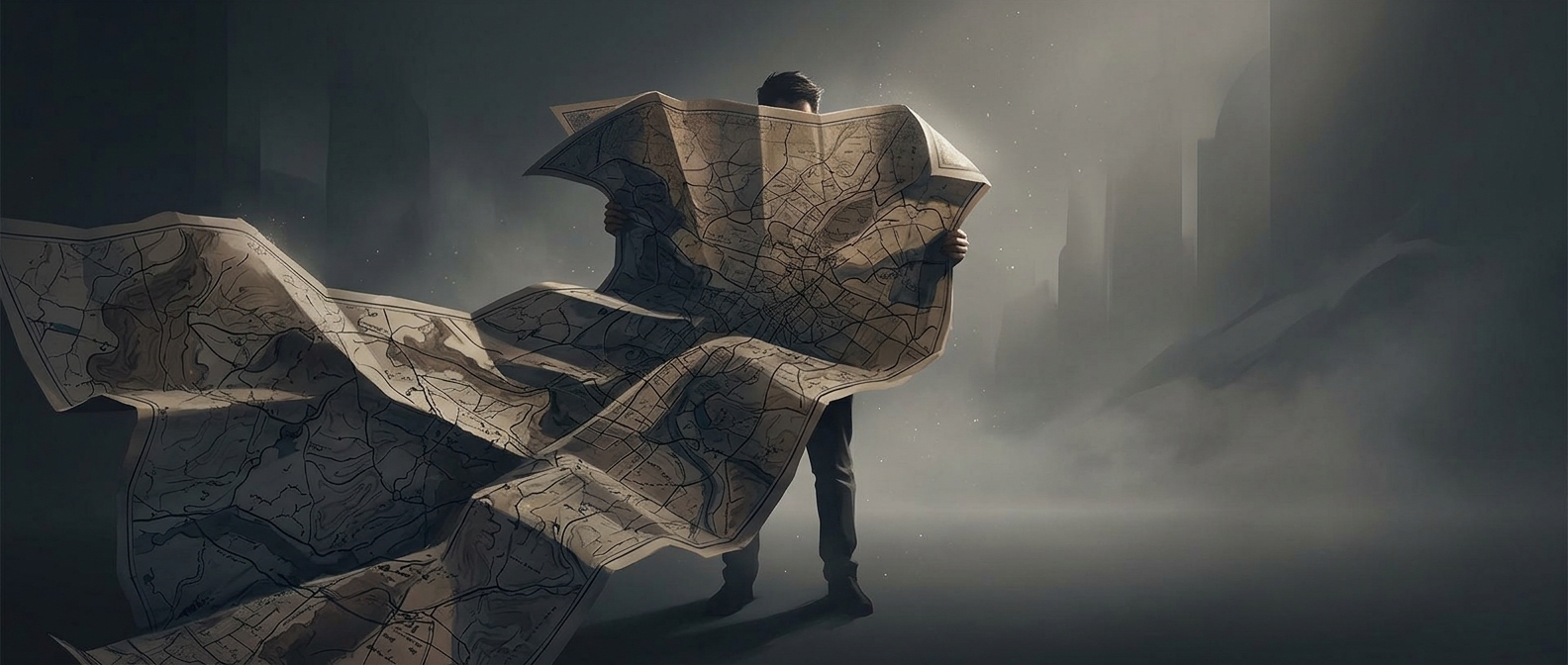
A map is a stack of folds, not one simple crease
A road map is usually folded in two directions. One set of folds turns the sheet into long strips; another set folds those strips into a compact packet. The result is a grid of panels, with some folds running across others. To put the map away, you have to reverse that sequence in the right order.
That order matters because each fold changes the shape of the sheet. A strip folded in half, for example, is now only half as wide, so a crosswise fold made afterward lands in a different place than it would on the open map. Start folding along the wrong crease and the panels may bunch up or overlap instead of forming a neat stack.
Creases are a guide, but not a hinge
Paper keeps a crease, but it does not behave like a rigid hinge: it can bend either way, and repeated handling softens the line. At a junction where several creases meet, the paper may have more than one plausible direction to fold. The map’s printed panels can also make it harder to see which edge should lie on top.
Many folded maps use an accordion pattern, in which neighboring panels alternate direction, combined with folds that bring the long strips together. If the sheet is fully opened, the existing creases reveal this pattern. The practical trick is to follow one direction at a time: restore the accordion first, then fold the resulting stack across, rather than trying to collapse the whole sheet at once.
The original fold has a hidden advantage
Maps are often designed to open into a broad sheet while still fitting a small storage space. That compactness comes from layering many panels, not from a single, intuitive fold. Once the original sequence is lost, the map still contains the clues—but finding the correct order is like solving a small paper puzzle. A slightly crooked first fold can shift every panel that follows, which is why the last few folds often seem to resist even when most of the map is already flat.