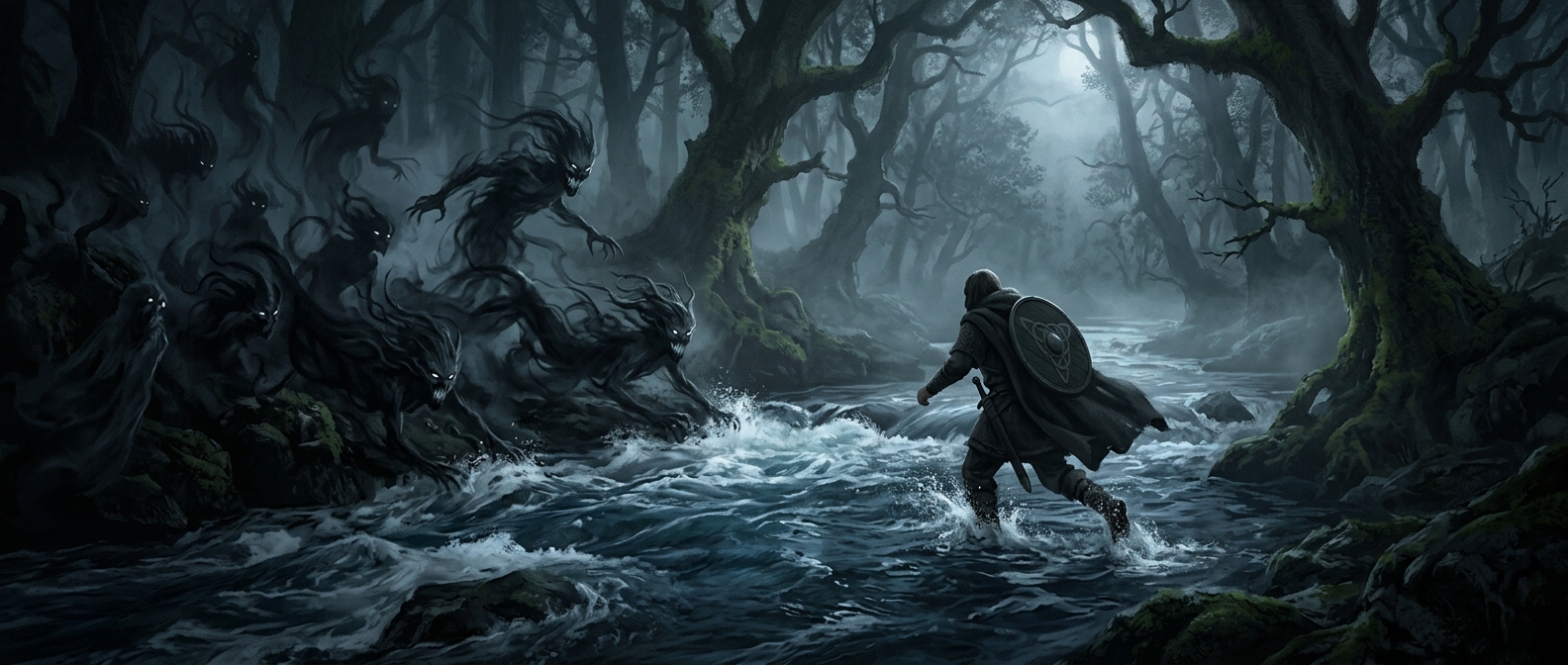
A moving boundary in the landscape
In Celtic and other European folklore, water could mark a boundary between ordinary human space and the dangerous or supernatural. A river was not just an obstacle to cross: its current made it a boundary that was continually moving, difficult to hold or command. In stories of pursuit, reaching such a stream could therefore change the chase’s terms.
Why the current mattered
The belief fits a wider folkloric idea that certain beings were constrained by borders, crossings, or particular places. A demon or other supernatural pursuer might follow a person along a road, but the flowing water between them could interrupt its power to follow. The stream did not have to defeat the pursuer in a fight; it offered escape by making the landscape itself protective.
Water also carried associations with cleansing and transition in many traditions. Those meanings help explain why a crossing could feel more consequential than simply putting distance between oneself and a pursuer: it separated one side from another, and the current kept that dividing line in motion.
A practical escape turned supernatural
The motif gives a memorable answer to a frightening question: what could a person do if something relentless was behind them? In the story, the answer was not a weapon or a faster horse, but a place where the world’s rules changed. A stream became a kind of natural threshold—one a pursued traveler might reach in a single desperate dash.