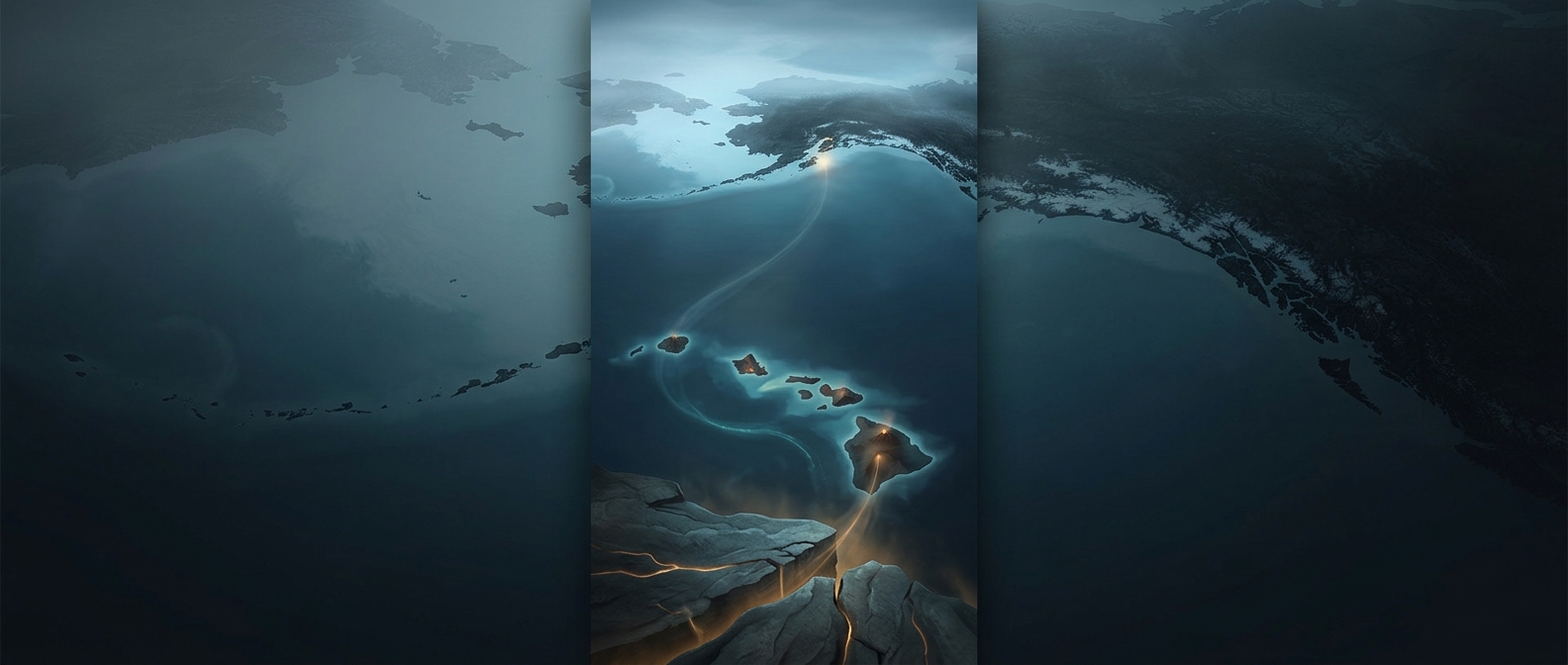
How Hawaii’s volcanoes leave a trail
The islands are carried along by the Pacific Plate, a huge slab of Earth’s outer shell that moves over the softer, slowly shifting rock beneath it. But the plate is only part of the story: Hawaii’s long chain of volcanoes records where that moving slab has passed over a comparatively fixed source of rising heat and molten rock, called a hotspot.
Magma—molten rock underground—can break through the crust and build a volcano. While a volcano sits above the hotspot, eruptions can keep adding material. As the plate carries it northwest, the volcano moves away from that supply. Eruptions dwindle, and waves and weather gradually wear the island down. A new volcano can form over the hotspot, extending the chain.
Islands change as they travel
This process helps explain why Hawaii is not a row of equally young, equally active islands. The Big Island lies over the hotspot today, while older islands farther northwest have had much longer to erode and sink. Their differences are a kind of geological timeline: position along the chain reflects how long each island has been moving with the plate.
The northwest drift points toward Alaska, but the islands are not on a short, direct journey to a travel destination there. Their movement is measured in inches per year, and the landscape changes far more noticeably through volcanic growth and erosion than through any shift a visitor could see. The islands themselves are snapshots of a much slower process—one that keeps building new land while carrying older land away from its source.