Bindu: the point before the world unfolds
In some Hindu and Tantric cosmologies, bindu—a Sanskrit word commonly meaning “point” or “drop”—stands for the concentrated beginning of manifestation. It is not a tiny physical object hidden somewhere in the universe. It is a symbolic way to imagine undivided potential: before there are distinct forms, directions, or beings, all are held in an unexpressed unity.
Calling bindu an “origin” therefore describes a cosmological idea, not a claim that scholars can locate a literal first instant or place. The point is imagined as having no measurable size, yet as the source from which multiplicity can emerge. That tension is the point of the image: the vastness of existence is traced back to something visually almost nothing.
From unity to a patterned world
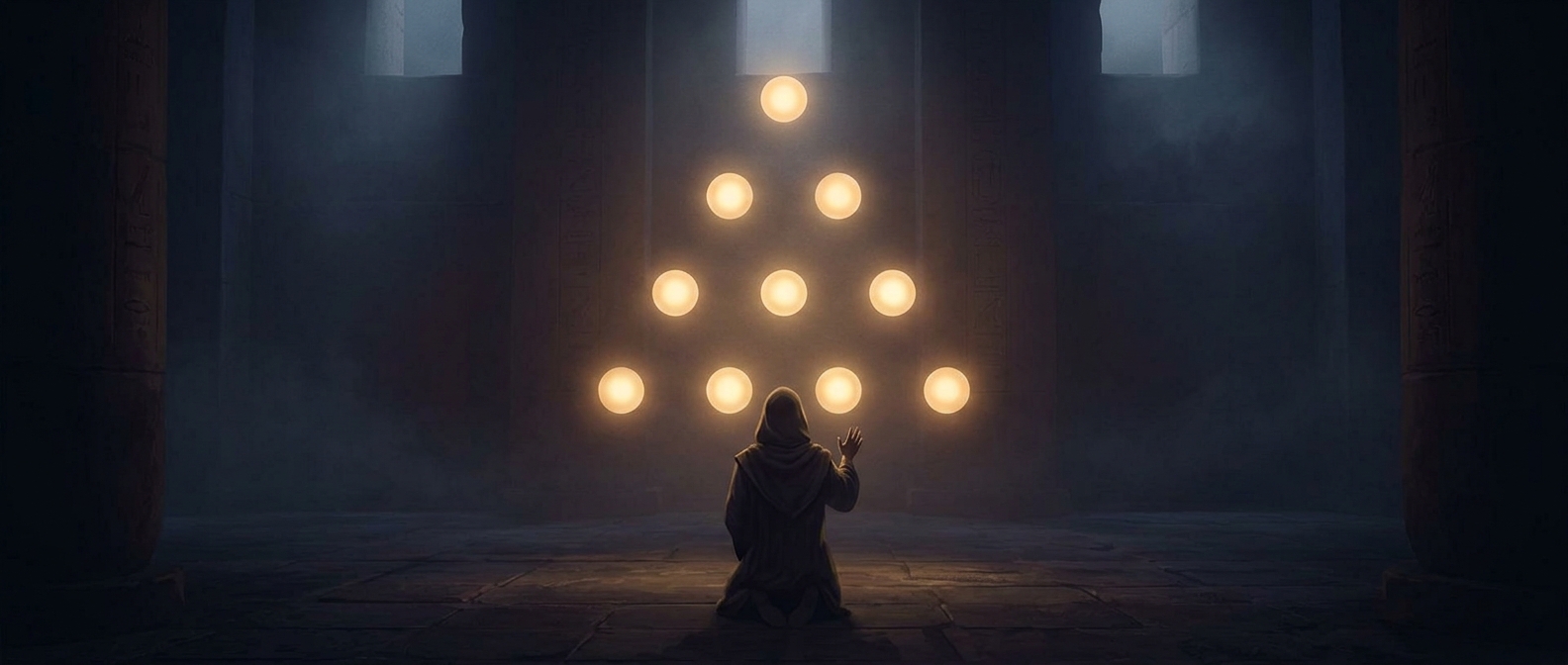
In ritual diagrams known as yantras, a central point can anchor surrounding lines, triangles, and circles. The eye moves outward from the center through increasingly elaborate forms. In some interpretations, that visual movement echoes the unfolding of the cosmos from unity into diversity; the inward movement suggests a return toward the source. The diagram makes an abstract teaching something a practitioner can contemplate rather than merely describe.
“Multidimensional” here is best understood in a spiritual or symbolic sense, not as a technical reference to extra dimensions in physics. Bindu connects origin, concentration, and potential in one compact image. Its striking implication is that, in this way of seeing the world, complexity does not begin as chaos: it is pictured as something already latent in a single point.