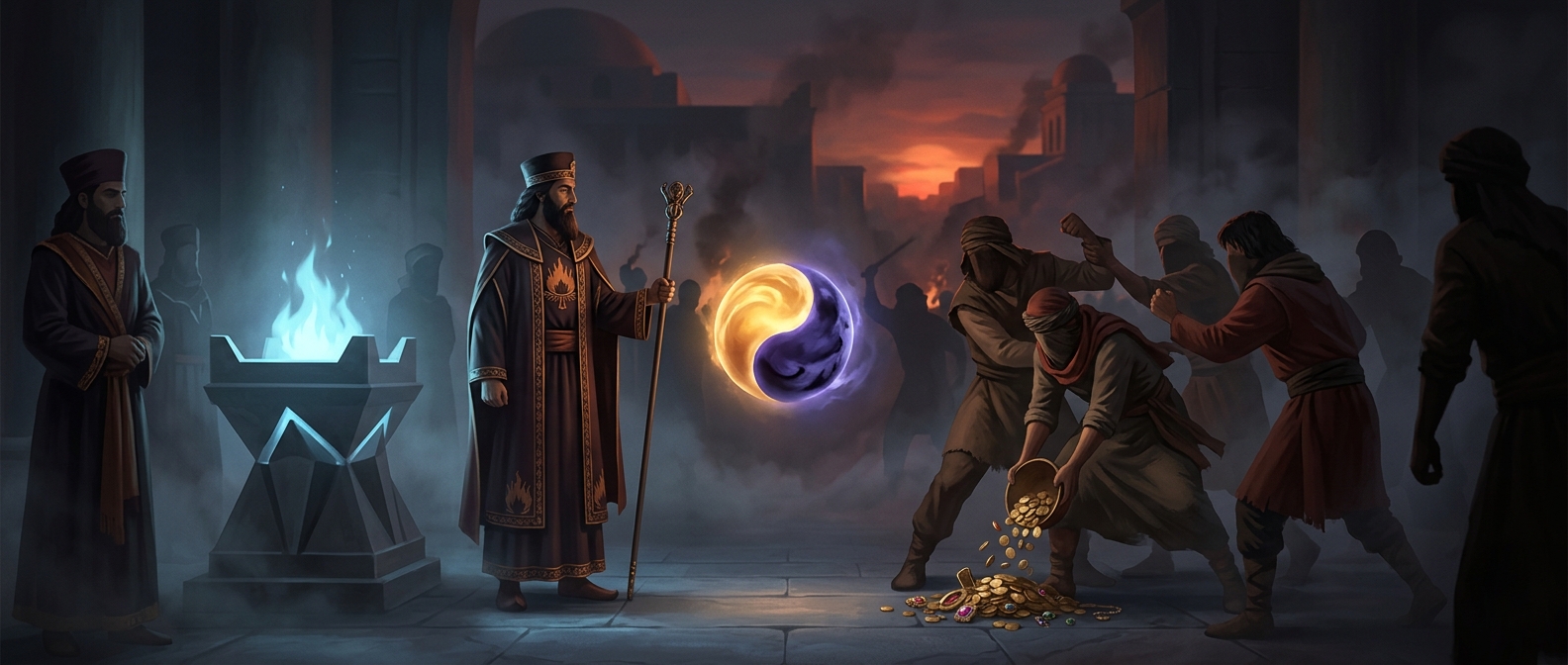
A cosmic battle became a social program
Mazdak’s teaching made inequality more than a political grievance: it could be understood as evidence that the world was still under the influence of Darkness. In the Persian religious world of the Sasanians, cosmic dualism—the struggle between opposing forces of good and evil—was a familiar way to explain disorder. Mazdak’s movement connected that grand conflict to everyday life, arguing that hoarded wealth and exclusive privilege helped sustain injustice.
That idea gave redistribution a spiritual purpose. Sharing property, and reportedly challenging aristocratic control over women, would weaken the social conditions associated with Darkness. The claim about harems survives through accounts shaped by the movement’s opponents, so it should not be treated as a simple, neutral record of what every follower demanded. But the charge itself reveals how threatening the movement seemed to the elite.
Why the dispute turned violent
Redistribution threatened the foundations of aristocratic power: land, wealth, and the authority to decide who could use them. The movement also gained influence at court under the Sasanian king Kavad I, making it more than a local protest. When the balance of power shifted, the ruling order had both a political motive and the means to crush it.
Kavad’s son Khosrow I led the later repression. The purge was therefore not just a clash over religious ideas. It was a struggle over whether the king and established elites would preserve a hierarchy that Mazdak’s followers had recast as part of a cosmic problem. The episode’s lasting force lies in that fusion: a demand to redistribute worldly privilege could be presented as a way to help Light prevail.