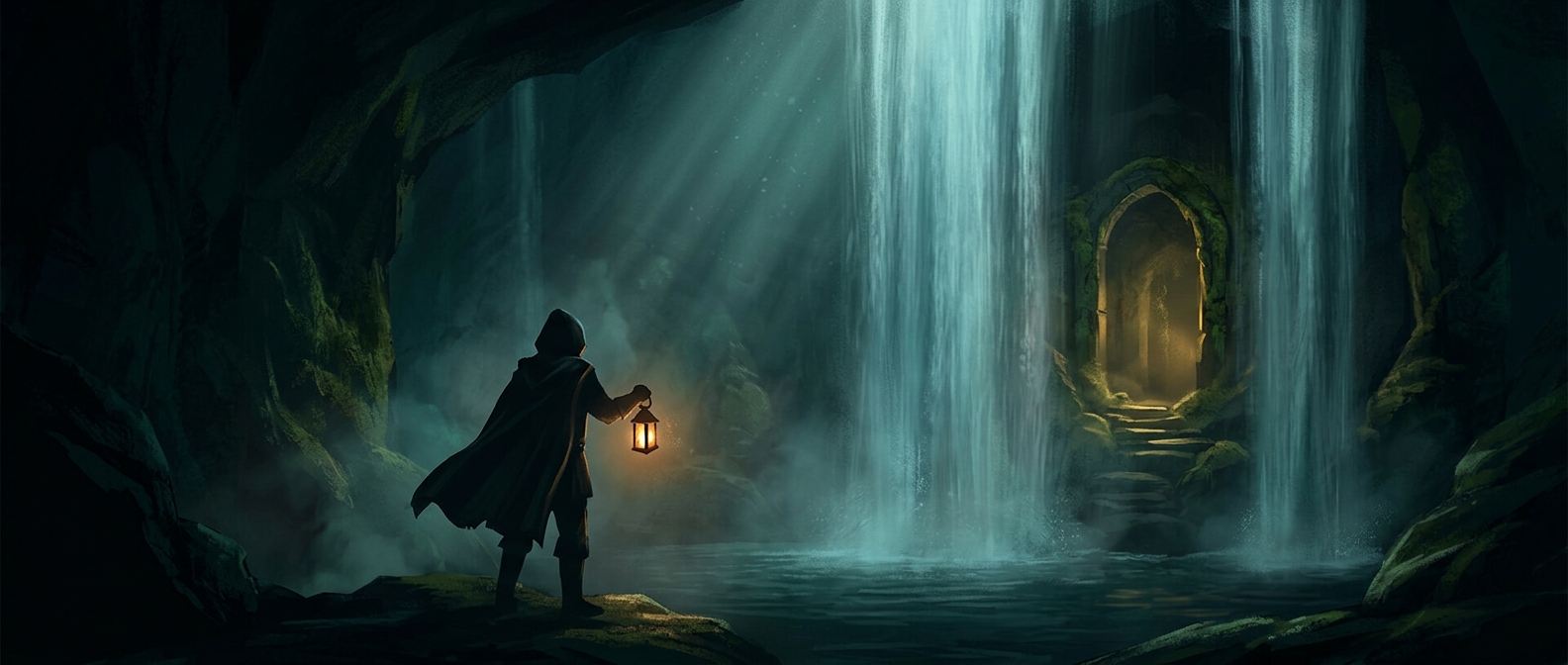
A waterfall is a ready-made hiding place
In a game, a waterfall does more than decorate a cliff. Its moving water obscures what lies behind it, while the rock face around it suggests a space the player might be able to enter. That combination makes it a naturally legible secret: players can wonder what is hidden there without needing a map marker or an explicit hint.
Designers can use that expectation to reward curiosity. A hidden passage or cache turns a small act of experimentation—walking through the water—into a discovery. The obstacle is also easy to understand: if the player can reach the falls, the game has shown them a plausible place to search.
Repeated discoveries become a rule of play
Once players find secrets in that setting, they start treating waterfalls as clues in other games, too. This is pattern recognition at work: a familiar visual feature suggests an action that has paid off before. The player may check not because the current game promised a reward, but because the convention has made checking seem worthwhile.
That expectation is useful to designers, but it creates a tradeoff. Putting a secret there can make exploration feel clever; leaving the space empty can make the search feel like wasted effort, especially when the game has trained players to inspect similar spots. A solid rock face is not inherently a mistake—it may simply mean this particular waterfall is scenery. But the convention has turned the spot into a question players expect the game to answer.