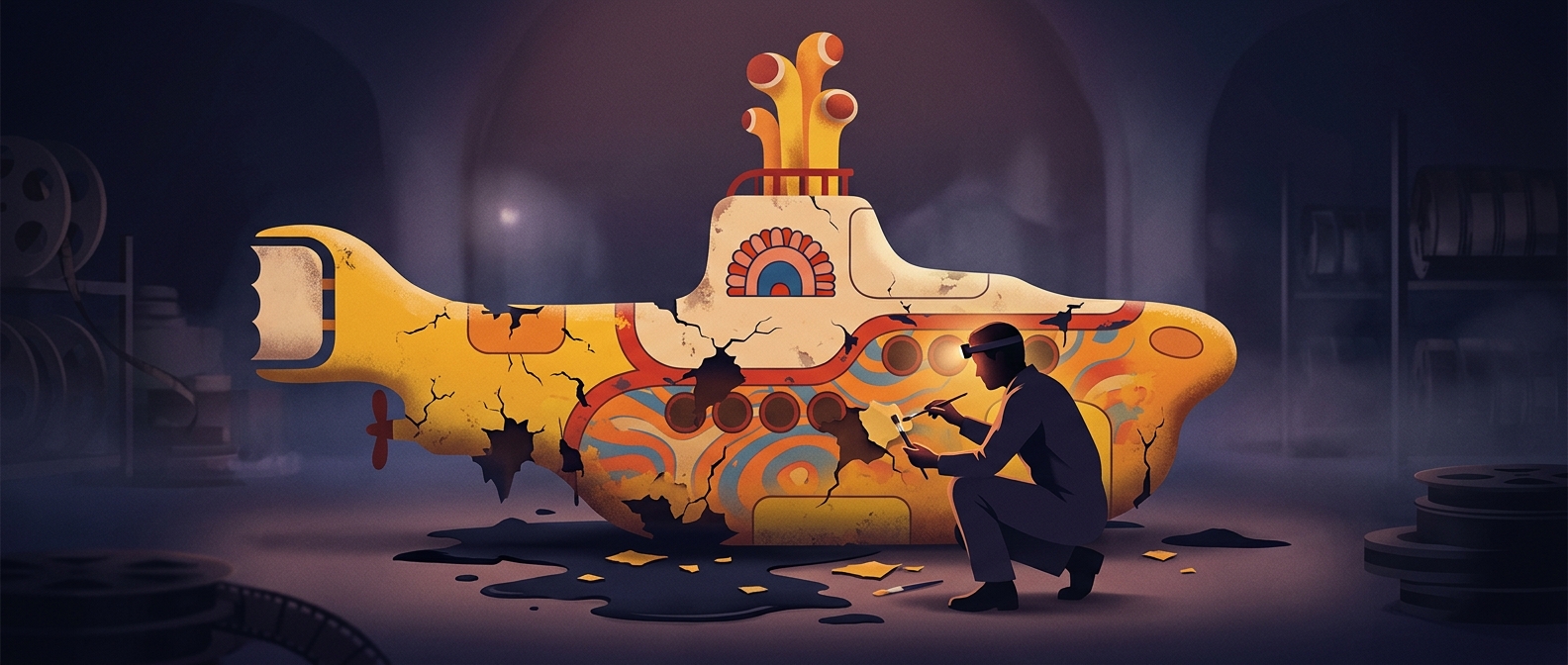
Why Yellow Submarine’s Colors Needed Rebuilding
The film’s bold look depends on color doing more than filling in outlines. In its animated world, a character or setting can shift from one vivid hue to another without becoming less recognizable; the changing palette is part of the visual play. When the original paints faded, that design language faded with them. A restored image could not simply be made brighter: it had to recover the particular colors and contrasts that made the scenes read as intended.
A Restoration Was Also an Act of Interpretation
Animation is assembled from many separate drawings, so a film’s color is built up across a sequence, not chosen once for a whole scene. Technicians working on the 1999 restoration reconstructed the palette by hand, making judgments about how the film’s colors should appear rather than relying on the aged paint as a dependable guide. The task was painstaking because a small mismatch can stand out when a saturated color repeats across successive images.
That work helped preserve more than a record of the original artwork. It kept the film’s exuberant visual rhythm legible for later audiences: the colors could once again carry the same visual weight as the drawings and movement. The near-loss is a reminder that animation can survive on film while the materials that give it its distinctive look quietly deteriorate.