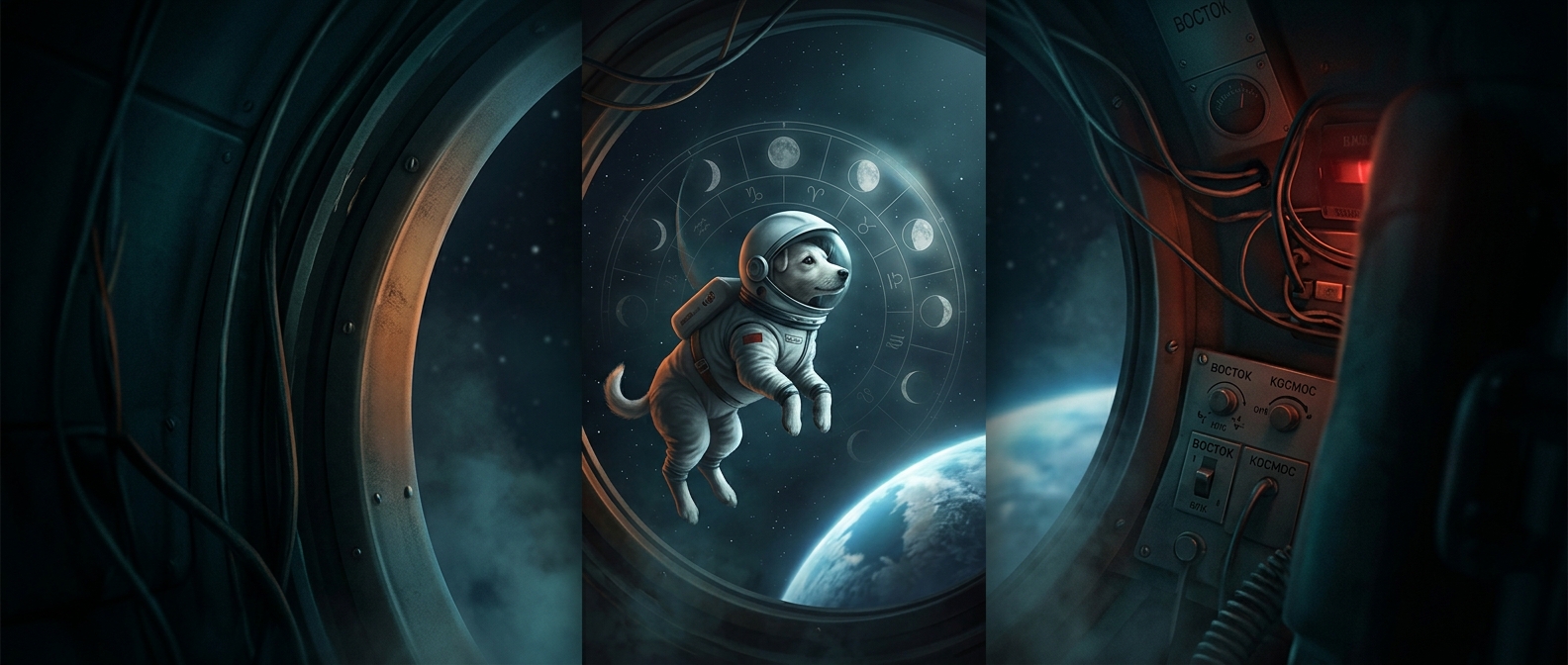
What Soviet dog launches actually involved
The claim that Soviet teams consulted lunar calendars to choose launch dates is best treated as a rumor, not an established part of the space program. Accounts of the missions do not provide reliable evidence that astrology or lunar omens guided launch decisions. A launch date had to fit practical constraints: the spacecraft and rocket had to be ready, the flight plan had to work, and the mission had to be safe enough to attempt.
The image of dogs sent directly into the vacuum is also misleading. A spacecraft had to provide a sealed, pressurized environment; without one, an animal could not survive. The dogs were test subjects inside spacecraft systems, where engineers could study how living bodies responded to launch and weightlessness.
Why the lunar-calendar story can sound plausible
Spaceflight combines precise timing with uncertainty, and Soviet missions were conducted under intense secrecy. That combination can make a rumor about hidden rituals feel believable: outsiders had limited access to the decision-making, while launch dates could appear mysterious. But a date selected to meet engineering or flight constraints is not evidence of astrological planning.
The distinction matters because these missions were risky experiments, not symbolic journeys. Their revealing detail is not that dogs were exposed to open space, but that engineers had to build life-support systems around them before a rocket could carry them beyond Earth.