A face that could survive the experiment
A mechanical television did not capture a whole picture at once. It sampled the scene bit by bit, using a rotating disk pierced with small holes. As the disk spun, each hole swept across the subject, breaking the image into lines. A light-sensitive cell converted changes in brightness into an electrical signal; a receiver had to reproduce those changes in step to rebuild the picture.
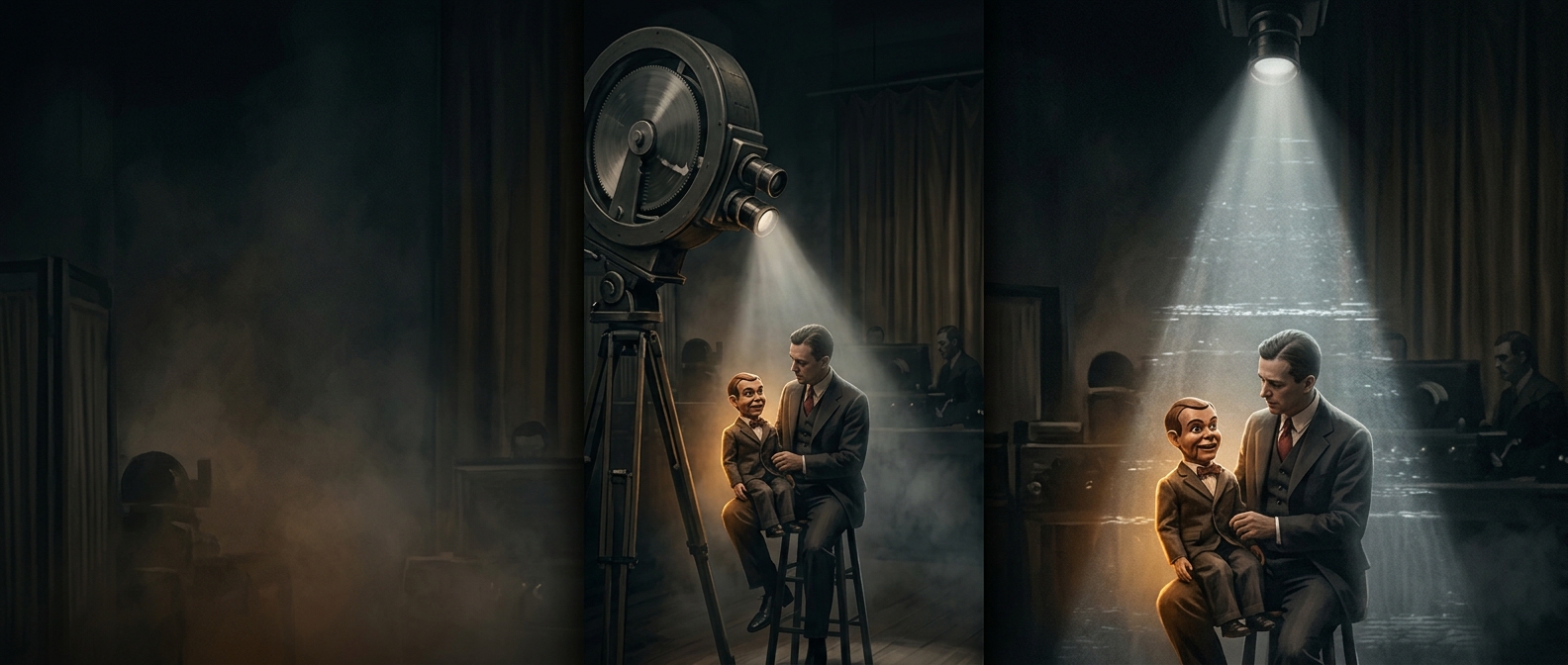
That process made the test subject matter. A face that shifted, blurred, or lacked clear light-and-dark patches could be difficult for the crude equipment to distinguish. Stooky Bill’s painted features gave Baird a fixed, strongly contrasting pattern to scan and check at the receiver.
Why a dummy was useful
A ventriloquist dummy could hold still while Baird adjusted the scanner and lighting. That was more than a convenience: early mechanical television needed very bright illumination, making a live person an uncomfortable subject. The dummy let the experiment focus on whether the machine could transmit recognizable changes in brightness, rather than on keeping a person in place.
The result was not television as viewers would later know it. Mechanical systems produced coarse, flickering images, and their rotating parts imposed a hard limit on how much detail they could show. But a recognizable head was a practical milestone: it demonstrated that the scanning-and-reassembly process could carry enough visual information for a receiver to form an image. Stooky Bill became a test pattern with a face—and, in the history of television, an unusually memorable one.