The machine needed an operator and a cleaner
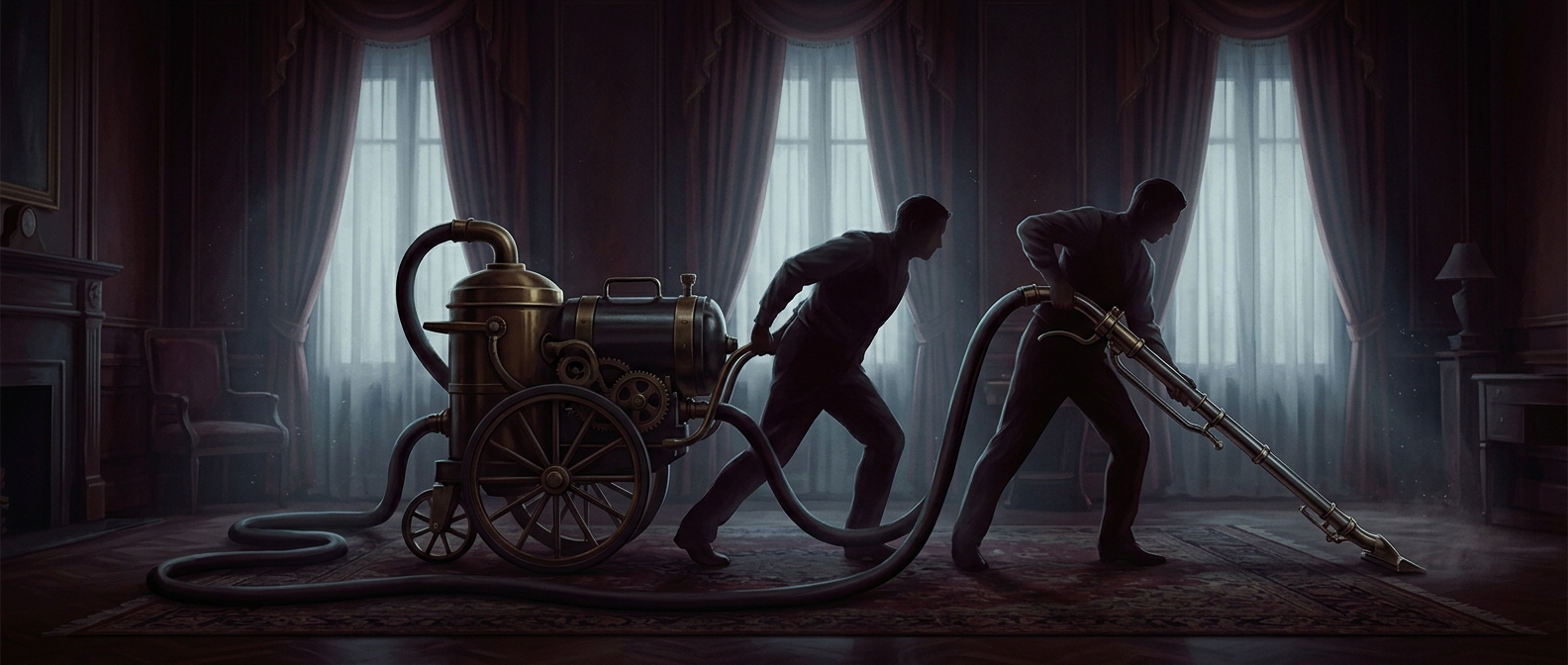
In early hand-powered vacuum cleaners, the work of cleaning began before the nozzle touched the floor. Turning a crank drove the mechanism that moved air through the machine. That airflow carried dust from the nozzle into a container or filter. Because the suction depended on continuous cranking, someone had to keep the mechanism running while another person steered the nozzle.
The arrangement made vacuuming a coordinated task rather than a one-person household chore. The person at the handle supplied the power; the person at the nozzle decided where to direct it. If the cranking stopped, so did the airflow—and the cleaning.
Why the design was cumbersome
A vacuum cleaner had to combine several jobs: draw in air, separate dust from that air, and hold the collected debris. In hand-powered models, it also needed a crank-driven mechanism large enough to produce useful airflow. The equipment could be awkward to move and operate while reaching around furniture, so dividing the work made practical sense.
That burden illustrates a basic constraint in appliance design: replacing sweeping with suction was useful only if a machine could generate and sustain that suction. Before a compact powered motor could do the work, the user’s effort was part of the machine’s power source.
A chore shaped by its technology
The two-person routine was not simply an odd household custom. It followed directly from how the cleaner worked. As powered designs made the machine itself supply the airflow, the operator no longer needed to keep a separate mechanism turning. The practical consequence was striking: a task that once called for coordinated labor could be handled by one person guiding a single appliance.